

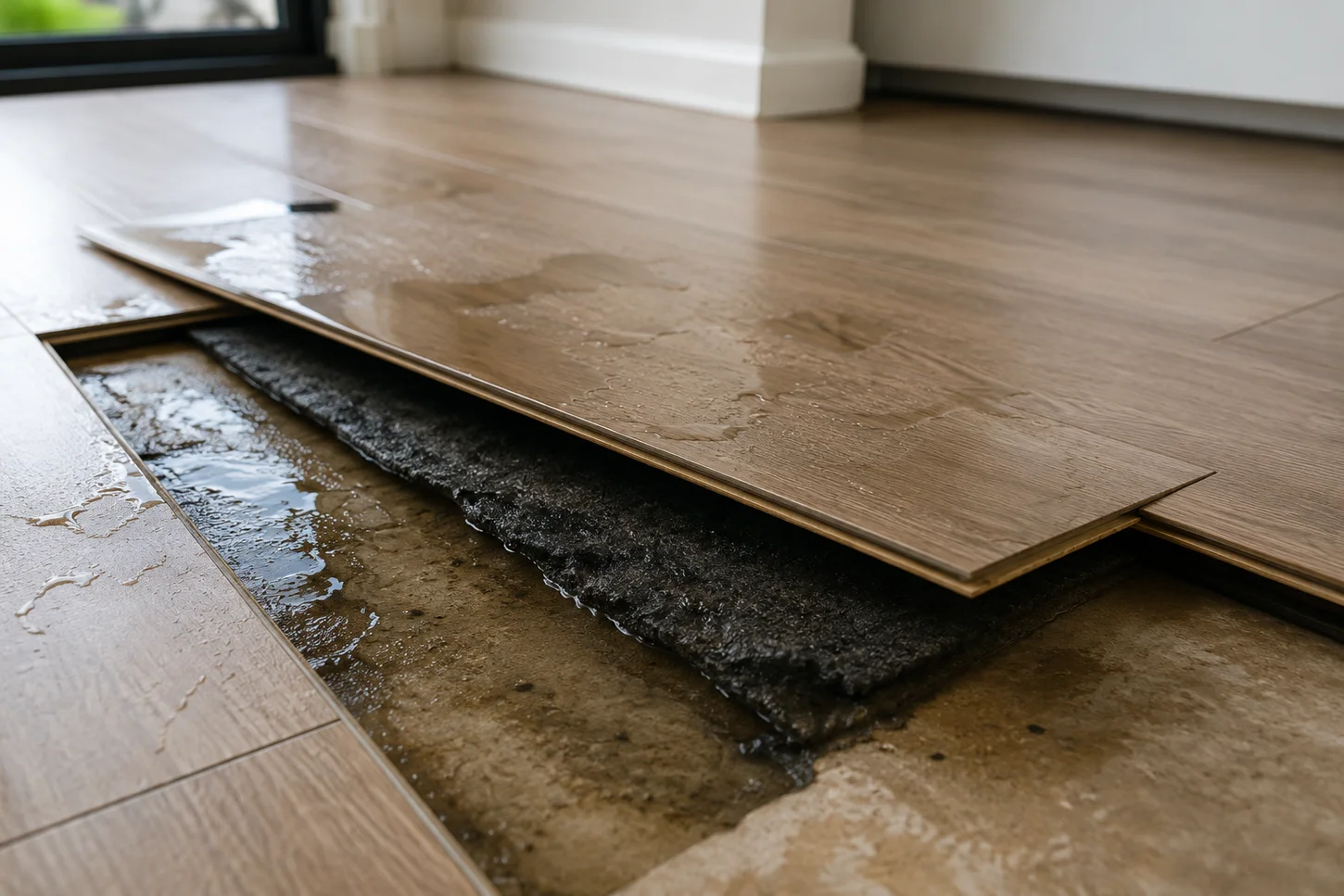

Hybrid flooring has become one of the most popular choices for Gold Coast homes — and it’s easy to see why. It looks great, handles everyday wear, and is marketed as waterproof. But here’s something many homeowners don’t realise until it’s too late: waterproof planks and a waterproof floor system are two very different things.
When water finds its way beneath hybrid flooring — whether from a burst pipe, a slow leak, or a Queensland storm — the consequences can range from a minor inconvenience to a costly repair job. Understanding what actually happens when moisture gets trapped under your floor is the first step toward protecting your home and your investment.
What Happens if Water Gets Under Hybrid Flooring?
Hybrid flooring is built with a waterproof core, which means the planks themselves won’t swell or warp when they get wet. That’s a genuine advantage over timber or laminate. But the floor system beneath those planks — the underlay, the subfloor, and the gaps between boards — is a different story.
Water that seeps under hybrid flooring doesn’t just evaporate on its own. It sits. It spreads. It saturates the underlay, works its way into the subfloor, and creates the kind of warm, damp environment that mould absolutely thrives in. Over time, this hidden moisture can undermine the structural integrity of your floor, produce persistent musty odours, and lead to a reinstallation that could have been avoided with faster action.
On the Gold Coast, where high humidity, heavy summer rainfall, and storm events are simply part of life, moisture problems under flooring aren’t rare. The climate means that even a modest amount of trapped moisture can escalate more quickly than it would in a cooler, drier region. That’s worth keeping in mind whether you’re installing new floors or dealing with an existing issue.
Is Hybrid Flooring Really Waterproof?
Understanding SPC and WPC Hybrid Flooring
The two main types of hybrid flooring are Stone Plastic Composite (SPC) and Wood Plastic Composite (WPC), and both are built around a waterproof core.
Stone Plastic Composite (SPC) uses a dense, rigid core made from limestone powder and PVC. It’s dimensionally stable, highly resistant to dents, and handles temperature fluctuations well — making it a solid choice for areas with underfloor heating or direct sunlight.
Wood Plastic Composite (WPC) incorporates wood fibre into the core alongside PVC, which gives it a slightly softer, more cushioned feel underfoot. It’s still waterproof at the core level, but tends to be a little less rigid than SPC.
Both types share one key feature: waterproof core technology. This means the plank itself won’t absorb water. Drop a glass of water on an SPC or WPC floor and it won’t soak into the plank. That’s genuinely useful — but it’s only part of the picture.
Waterproof Doesn’t Mean Waterproof Installation
This is where the confusion starts. The plank is waterproof. The floor system is not necessarily.
Hybrid flooring is installed as a floating floor, which means the planks interlock and sit over the subfloor rather than being glued or nailed down. That design has real advantages, but it also means:
- Water can travel through joins. The click-lock connections between planks aren’t perfectly sealed. Water that sits on the surface long enough — or enters from the side — can migrate through the joins and reach the underlay below.
- Expansion gaps create entry points. Hybrid flooring requires gaps around walls and fixed objects to allow for natural movement. These gaps, while necessary, are also paths water can follow when spills or leaks are significant.
- Moisture can become trapped beneath floating floors. Because the floor isn’t bonded to the subfloor, any moisture that gets underneath has limited ways to escape. Without direct airflow or intervention, it can sit there indefinitely.
The Difference Between Waterproof, Water-Resistant, and Moisture-Proof
These three terms are often used interchangeably in flooring marketing, but they mean different things — and the distinction matters.
| Term | What It Means |
| Waterproof | The material will not absorb water or be permanently damaged by it. Refers to the plank core. |
| Water-resistant | The material can handle incidental moisture but is not immune to prolonged exposure. |
| Moisture-proof | Not a standard technical term in flooring — often used loosely in marketing material. |
The plank core of hybrid flooring is genuinely waterproof. But the floor as a whole — including the underlay, subfloor, and installation — is not. Many homeowners assume “waterproof flooring” means the entire system is protected, and that misunderstanding can lead to delayed action when a leak occurs.
How Does Water Get Under Hybrid Flooring?
Plumbing Leaks
Plumbing is one of the most common causes of water damage under flooring, and it can be deceptively difficult to detect.
- Burst pipes tend to cause sudden, visible flooding — you’ll know about it quickly.
- Slow leaks behind walls are far more insidious. A pinhole leak or a loose fitting can drip for weeks or months before it becomes obvious. By the time you notice discolouration on the skirting board or a soft spot underfoot, moisture may have spread significantly.
- Dishwasher and fridge water lines are a surprisingly frequent culprit. These supply lines are often overlooked during maintenance and can develop slow leaks that sit beneath kitchen flooring for extended periods.
Flooding and Storm Damage
Gold Coast residents are no strangers to heavy rain. Queensland storm season — generally from November through March — can bring intense rainfall, rising water, and in some cases, localised flooding.
When stormwater enters a home through doors, windows, or subfloor vents, it can get under flooring quickly. Low-lying homes and properties with inadequate drainage are particularly vulnerable. In these events, water doesn’t just pool on the surface — it finds every gap and works its way into the floor system.
Bathroom or Laundry Overflows
Overflowing baths, blocked drains, and washing machine leaks are everyday domestic scenarios that can cause moisture under hybrid flooring. These events often affect adjoining rooms — a laundry overflow can easily reach the hallway or bedroom beyond it. The floor surface may look unaffected while moisture spreads unseen beneath.
Soaking or Sloshing Mops
This is a common but easily avoidable issue. Hybrid flooring should be cleaned with a lightly damp mop — never a soaking wet one. When excess water is applied to the surface regularly, it can work its way through the joins and accumulate beneath the planks over time. It’s a slow process, but it does cause damage, particularly to the underlay and any timber subfloor components.
Steam Mops
Steam mops are a firm no for hybrid flooring. The combination of heat and concentrated moisture forces steam directly into the joins and surface of the floor, breaking down adhesive bonds, softening the wear layer, and driving moisture into areas it should never reach. Most hybrid flooring manufacturers explicitly void warranties when steam mops are used, and for good reason.
Moisture Rising Through Concrete Slabs
This is a less obvious but very real moisture source — and it’s particularly relevant for Gold Coast homes built on concrete slabs.
- Rising damp occurs when moisture from the ground migrates upward through a concrete slab. Older homes, and homes in areas with high water tables or clay-heavy soil, are more susceptible.
- Poor vapour barrier installation can allow moisture to pass through the slab and reach the underlay. A vapour barrier is only effective when it’s correctly sized, sealed at the edges, and free of tears or gaps.
- Moisture migration can also result from a slab that hasn’t fully cured. New concrete holds a significant amount of moisture, and laying flooring too early is a known cause of ongoing problems.
What Actually Happens When Water Gets Under Hybrid Flooring?
The Planks Usually Survive
Here’s the good news: in most cases, the hybrid planks themselves will be fine. The waterproof core means they don’t absorb moisture, don’t swell, and don’t delaminate from a brief or contained water event. If you can get to the source quickly and dry out the subfloor, the planks can often be relaid without replacement.
The Underlay Can Become Saturated
Standard foam underlay absorbs moisture readily. Once saturated, it takes a long time to dry and can become a breeding ground for mould. Some underlay products have better moisture resistance than others, but most are not waterproof. A saturated underlay needs to be removed and replaced — it cannot simply be dried out in place.
Timber Subfloors Can Swell and Warp
Homes with timber subfloors — particularly older properties — face more risk when water gets under the flooring. Timber absorbs moisture, swells, and can warp significantly. A swollen subfloor creates an uneven surface that affects the entire floor above it. In severe cases, structural repairs may be required before new flooring can be installed.
Concrete Subfloors Can Trap Moisture
Concrete doesn’t absorb water the way timber does, but it’s not immune. When water sits on or beneath a concrete slab, it can become trapped — especially if a vapour barrier is blocking evaporation upward and there’s no downward drainage path. This trapped moisture elevates the humidity directly beneath the floor, creating conditions that damage underlay and promote mould growth.
Mould and Mildew Can Develop
Mould is the most serious long-term consequence of water under hybrid flooring. It typically begins in the underlay and can spread to the subfloor and even the underside of the planks. Mould doesn’t need visible water to grow — elevated humidity in a warm, enclosed space is enough. Once established, it’s difficult to fully remediate without lifting the floor.
Persistent Musty Odours May Appear
One of the earliest signs of mould growth under flooring is a musty smell — earthy, damp, and distinctly unpleasant. Many homeowners notice this smell before they see any visible signs of damage. If your floor smells off but looks fine, that’s worth investigating rather than ignoring.
Locking Systems May Become Compromised
Prolonged moisture exposure can affect the click-lock mechanisms between planks. In some cases, swelling of the subfloor or underlay pushes against the locking system, causing planks to separate or become difficult to re-engage. This affects the stability of the floor and can create tripping hazards or allow further moisture ingress.
Signs Water Has Gotten Under Your Hybrid Flooring
A Musty or Damp Smell
As noted above, this is often the first sign. A persistent musty odour coming from the floor area — particularly in bathrooms, kitchens, or rooms adjacent to a recent leak — is a prompt to investigate.
Soft or Spongy Areas
If a section of your floor feels soft or gives slightly when you walk on it, the underlay beneath may be saturated. Healthy underlay and subfloor should feel firm and consistent underfoot.
Clicking or Movement When Walking
Hybrid flooring that was previously stable but now clicks, shifts, or feels loose may have experienced subfloor movement due to moisture. The locking joints can loosen when the surface beneath them changes shape.
Lifting or Peaking Between Planks
When moisture causes the subfloor to swell or shift, it can push planks upward at the joins — a phenomenon known as peaking. You’ll see a visible ridge running along the join between two planks.
Gaps Appearing Between Boards
Conversely, if moisture affects the expansion and contraction dynamics of the floor system, gaps can open between boards. This can also happen when a floor is installed without adequate expansion gaps, then pushed back by swelling — the relief has to go somewhere.
Dark Stains Along Joins
Discolouration along the joins or edges of planks — often dark brown, grey, or greenish — can indicate mould or moisture damage beneath the surface. These stains often show up where water has consistently entered over time.
Visible Mould Around Skirting Boards
Mould growing at the base of skirting boards — or visible behind them when they’re removed — is a clear indicator that moisture has reached the edges of the floor. This is a serious sign that warrants immediate professional assessment.
How Long Can Water Sit Under Hybrid Flooring Before Damage Occurs?
The First 24 Hours
Within the first day, the risk is primarily to the underlay. Water begins to spread horizontally beneath the floor, but mould hasn’t had time to establish. If the source is stopped and drying begins promptly, the chances of saving the floor without major intervention are relatively good.
24–48 Hours
After 48 hours, moisture levels in the underlay will be significantly elevated. If the subfloor is timber, it may already be beginning to absorb moisture. The risk of mould spores taking hold increases substantially. Fans and dehumidifiers need to be deployed urgently, and professional assessment becomes advisable.
Several Days
After several days of trapped moisture, mould growth is likely. The underlay may be beyond salvage. Timber subfloors will have absorbed moisture and may be starting to show movement. The situation will typically require the floor to be lifted in affected areas.
Weeks or Months Later
If a slow leak goes undetected for weeks or months — as sometimes happens with behind-wall plumbing or under-slab moisture — the damage can be extensive. Mould may have colonised large areas of the underlay and subfloor, and the structural integrity of a timber subfloor may be seriously compromised. Remediation at this stage is complex and costly.
Why Fast Action Makes a Huge Difference
The message here is straightforward: the sooner you act, the better the outcome. A leak that’s addressed within hours is a manageable problem. A leak that’s left for weeks becomes a significant renovation. Speed matters more than almost any other factor.
What Should You Do If Water Gets Under Hybrid Flooring?
Stop the Water Source Immediately
Before anything else, address the source. Turn off the water supply if it’s a plumbing issue. If it’s stormwater or flooding, focus on diverting or pumping water away from the affected area.
Remove Surface Water
Use towels, a wet/dry vacuum, or a mop to remove as much surface water as possible. The faster you get standing water off the floor, the less will migrate through the joins.
Increase Ventilation
Open windows and doors to increase airflow through the space. Cross-ventilation is particularly effective. The goal is to reduce the ambient humidity in the room as quickly as possible.
Use Fans and Dehumidifiers
Position fans to move air across the surface of the floor and, if possible, direct airflow at skirting board gaps. A dehumidifier running continuously will significantly speed up the drying process and help pull moisture from the underlay.
Contact a Flooring Professional
If the water event was more than a minor spill — a burst pipe, a major leak, or storm flooding — contact a flooring professional before assuming the floor is fine. Many moisture problems aren’t visible from the surface, and a professional can assess what’s happening beneath the planks.
When Flooring Needs to Be Lifted
In cases of significant water intrusion, lifting sections of the floor is often the most effective way to dry out the underlay and subfloor. A professional can remove planks carefully, replace the underlay, allow the subfloor to dry, and reinstall. Because hybrid planks themselves are usually undamaged, much of the flooring can often be reused.
When Water Damage Requires Insurance Claims
Major water damage events — storm flooding, burst pipes, appliance failures — may be covered by home and contents insurance. Document the damage thoroughly with photos before any remediation begins, and contact your insurer promptly. Keep records of all professional assessments and repair work.
Can Hybrid Flooring Be Saved After Water Damage?
Minor Spills
A drink knocked over, a mop that was too wet — these are generally low-risk events. Wipe up quickly, dry the surface, and monitor for a few days. No intervention is typically needed if the moisture hasn’t had time to penetrate through the joins.
Localised Leaks
A dishwasher line leak caught reasonably early, or a bathroom overflow limited to one room — these are manageable. The affected section of flooring may need to be lifted, the underlay replaced, and the subfloor dried and treated before relaying. In many cases, the planks can be reused.
Major Flood Events
Significant flooding — whether from storm damage or a catastrophic plumbing failure — typically requires professional remediation. The underlay will almost certainly need replacing, and the subfloor will need to be assessed and treated. In severe cases, structural subfloor repairs may be needed before new flooring goes down.
When Only a Few Boards Need Replacement
If damage is isolated — a handful of boards that have been compromised by a point-source leak — replacement of those specific planks is straightforward, provided the same product is still available. This is one advantage of the modular nature of click-lock hybrid flooring.
When the Entire Floor May Need Reinstallation
In cases of widespread moisture damage — particularly where mould has spread across a large area of underlay and subfloor — a full reinstallation may be the most practical and safest option. A professional assessment will clarify the scope.
What Happens to Different Types of Subfloors?
Concrete Slabs
Concrete doesn’t swell or warp like timber, which is an advantage. However, it can hold moisture for extended periods and create elevated humidity beneath the flooring. The key concern is mould in the underlay and ensuring the slab moisture content is within acceptable limits before relaying.
Timber Subfloors
Timber is the most vulnerable subfloor type when exposed to moisture. It absorbs water, swells, and can develop structural weakness if exposure is prolonged. Joist damage in particular can be a serious and expensive problem. Timber subfloors need to be fully dried and assessed before any new flooring is installed.
Particleboard
Particleboard is extremely sensitive to moisture. It swells dramatically when wet, loses structural integrity quickly, and rarely recovers fully once it has absorbed significant moisture. Wet particleboard typically needs to be replaced rather than dried out.
Plywood
Plywood handles moisture better than particleboard and better than solid timber in many cases, due to its cross-laminated construction. Moderate moisture exposure may be manageable, but significant saturation can still cause swelling and delamination. Assessment after a water event is important.
Existing Tile Subfloors
Hybrid flooring installed over existing tiles is common on the Gold Coast. Tiles themselves don’t absorb moisture, but the grout lines can allow water to seep through to the adhesive and the structure below. If water gets under the hybrid floor and into cracked grout or damaged tiles, the moisture can reach the concrete slab beneath.
How Professionals Assess Hidden Moisture
Moisture Meter Testing
A professional will use a moisture meter to test the subfloor in multiple locations. This gives a quantitative reading of moisture content and can identify elevated areas even when the floor surface looks dry. Acceptable moisture levels vary by subfloor type, but any reading significantly above baseline warrants attention.
Thermal Imaging
Thermal imaging cameras can detect temperature variations caused by trapped moisture — wet areas often appear cooler than dry ones. This non-invasive technique can map moisture spread without lifting the floor, helping to identify the full extent of a problem quickly.
Lifting Sample Boards
In some cases, the most practical approach is to lift a small number of planks in the suspected area and directly inspect the underlay and subfloor. This is done carefully by an experienced installer who can relay the boards without damage.
Inspecting the Underlay
Once the floor is partially lifted, the underlay tells a clear story. Discolouration, compression, odour, and visible mould growth are all reliable indicators of moisture damage.
Checking for Mould Growth
A thorough assessment will include checking the underside of boards, the top and underside of the underlay, and the surface of the subfloor for mould. In some cases, swabbing for laboratory analysis may be warranted if extensive mould is suspected.
How to Prevent Water Getting Under Hybrid Flooring
Clean Up Spills Quickly
The simplest preventive measure: when liquid hits the floor, clean it up promptly. Don’t let spills sit while you finish what you’re doing. A few minutes can make a meaningful difference.
Avoid Soaking or Sloshing Mops
Use a microfibre mop lightly dampened with a suitable cleaner — never a soaking wet mop. Excess water from mopping is one of the most common causes of gradual moisture accumulation beneath hybrid flooring.
Avoid Steam Mops
Steam mops are not compatible with hybrid flooring. The heat and moisture combination can damage the wear layer and drive moisture through the joins. Stick to mops designed for hard floors.
Fix Plumbing Leaks Early
Don’t ignore that slow drip under the kitchen sink or the faint discolouration at the base of the vanity cabinet. Slow leaks are responsible for a significant proportion of flooring water damage precisely because they’re easy to overlook until real damage has occurred.
Install Proper Moisture Barriers
A quality vapour barrier between a concrete slab and the underlay is essential — particularly for Gold Coast homes where slab moisture and humidity can be elevated. The vapour barrier should be correctly overlapped and sealed at joins.
Ensure Correct Expansion Gaps
While this doesn’t prevent water ingress, inadequate expansion gaps can make damage worse. A floor without proper gaps has nowhere to move when moisture causes the subfloor to shift, leading to more severe peaking or buckling. Proper gaps are a basic installation requirement.
Choose Professional Installation
The best prevention for moisture problems under flooring is correct installation from the start. This means moisture testing before laying, correct subfloor preparation, appropriate underlay selection, and adherence to manufacturer guidelines. It’s much easier to get this right at installation than to fix it afterward.
For a broader look at installation mistakes that can lead to moisture problems, see common mistakes when installing hybrid flooring.
Why Proper Installation Matters More Than Most Homeowners Realise
Moisture Testing Before Installation
A reputable installer will test subfloor moisture content before laying any flooring. Concrete slabs need to meet specific moisture thresholds — laying flooring over a slab that’s still releasing excess moisture is one of the most common causes of long-term problems.
Flat, Dry Subfloors
Hybrid flooring requires a flat, dry subfloor to perform correctly. High spots, dips, or soft areas should be addressed before installation. An uneven subfloor not only affects the feel of the floor but can create stress points where the locking system is more likely to fail.
Quality Underlay Selection
Not all underlay products are equal. For Gold Coast homes — where humidity is consistently higher than in inland areas — selecting an underlay with appropriate moisture resistance is worth the additional consideration. Some underlays include integrated vapour barriers, which can simplify the installation process.
Correct Edge Sealing
In wet areas like bathrooms and laundries, edge sealing around penetrations, drains, and wall junctions is important. Silicone sealant applied correctly at these points reduces the risk of water finding its way beneath the floor.
Following Manufacturer Installation Guidelines
Every hybrid flooring product comes with specific installation requirements from the manufacturer. These aren’t just suggestions — they’re the conditions under which the product will perform as intended and the warranty will remain valid. Deviating from them — particularly on subfloor preparation and expansion gaps — creates risk.
Common Myths About Water and Hybrid Flooring
“Hybrid Flooring Can’t Be Damaged by Water”
The planks can resist water. The floor system — underlay, subfloor, locking joints — cannot. This is the most important distinction to understand, and the one most often glossed over in general marketing.
“Hybrid Flooring Can Just Be Left Intact After a Flood”
Because the planks themselves survive a flood event in good condition, it’s tempting to assume the floor is fine and leave it in place to dry out. It’s not a safe assumption. The underlay will almost certainly be saturated, the subfloor may have absorbed significant moisture, and mould can begin establishing within 24–48 hours in warm Queensland conditions. Leaving the floor down after flooding is one of the most common decisions that turns a manageable problem into a full reinstallation.
“Steam Cleaning Is Safe”
Steam cleaning is not safe for hybrid flooring. It forces heat and moisture through the surface and joins in a way that standard cleaning does not. Most manufacturers explicitly exclude steam mop damage from their warranties.
“If the Planks Look Fine, Everything Is Fine”
The planks looking good is actually not a reliable indicator of floor health when water is involved. Significant mould and moisture damage can exist beneath a floor that appears perfectly normal from the surface. If you’ve had a water event, don’t rely on the visual — get it assessed.
“The Floor Will Dry Out by Itself”
A minor surface spill that’s wiped up quickly can evaporate without issue — but that’s very different from moisture that has already worked its way beneath the planks. Once water is trapped under a floating floor, the enclosed space receives almost no airflow. It doesn’t dry out on its own in any meaningful timeframe. Relying on natural drying for anything beyond a surface-level incident is a risk that tends to result in mould, subfloor damage, and a much costlier fix down the track.
Frequently Asked Questions
Can mould grow under hybrid flooring?
Yes. Mould can grow under hybrid flooring when moisture becomes trapped beneath the planks — typically in the underlay or on the subfloor surface. The planks themselves are resistant to mould, but the materials beneath them are not. Warm, humid conditions — common on the Gold Coast — accelerate mould development.
Can hybrid flooring dry naturally after flooding?
In minor cases, yes. But for significant water events — storm flooding, burst pipes, appliance leaks — natural drying is generally insufficient. The enclosed space beneath the flooring has limited airflow, and moisture can persist for weeks without active drying measures. Professional intervention is advisable for anything beyond minor spills.
How do I know if water has reached the subfloor?
Signs include a musty smell, soft or spongy areas underfoot, movement or clicking when walking, peaking at the joins, or visible mould around skirting boards. Definitive assessment requires moisture meter testing by a professional, which can detect elevated moisture levels even when there are no visible symptoms.
Should hybrid flooring be removed after a major leak?
In many cases, yes — at least in the affected area. Removing the flooring allows the underlay and subfloor to be properly dried, assessed, and treated. The planks themselves can usually be reinstalled if they’re undamaged. A professional flooring assessment will clarify the extent of removal required.
Can insurance cover water damage to hybrid flooring?
Home insurance policies vary, but many will cover sudden and accidental water damage — such as burst pipes or storm flooding — including damage to flooring. Gradual leaks that could have been detected and repaired are sometimes excluded. Always document damage thoroughly before any remediation and contact your insurer promptly after a significant water event.
Is hybrid flooring suitable for bathrooms and laundries?
This depends on the specific area and how the installation is approached — it’s not a straightforward yes.
Hybrid flooring is commonly used in laundries and ensuite-adjacent areas, but full bathrooms in Queensland are subject to specific building requirements under the National Construction Code (NCC) and Australian Standard AS 3740. These standards require a compliant waterproof membrane beneath the floor covering in wet areas — hybrid floating flooring on its own does not satisfy this requirement.
Additionally, floating floors can present challenges with the floor falls (slope to drain) required in bathrooms. Many hybrid flooring manufacturers also exclude full wet areas from their warranty coverage, so it’s important to check the specific product’s warranty documentation before installation.
If you’re considering hybrid flooring near a bathroom or laundry, speak with a professional installer who can advise on what’s compliant and appropriate for your specific space. The team at Award Carpets Gold Coast can help you understand your options and ensure any installation meets current building requirements.
How can I prevent moisture problems in Queensland homes?
A combination of good habits and correct installation goes a long way. Clean spills promptly, use only a lightly damp mop (never a soaking wet one), use only damp-mop-compatible cleaners, fix plumbing issues quickly, and ensure your floor was installed with proper vapour barriers and moisture testing. In Queensland’s climate, maintaining good ventilation through the home also helps manage ambient humidity.
Why Choose Award Carpets Gold Coast for Hybrid Flooring?
Choosing the right flooring is one thing. Making sure it’s installed correctly — and suited to where you actually live — is another. That’s where the team at Award Carpets Gold Coast comes in.
As an independent, family-run business with more than 30 years of experience on the Gold Coast, we know the local climate, the local challenges, and what it takes to install flooring that lasts. We work with homeowners and commercial clients across the region, and we see firsthand how often moisture problems come down to installation decisions rather than product quality.
What we offer:
- Professional moisture assessment before installation — We test subfloor moisture levels before any flooring goes down, so you’re not laying a new floor over a problem waiting to happen.
- Premium hybrid flooring Gold Coast brands — We stock quality hybrid flooring options that are suited to Australian conditions, including the humidity and temperature variations common on the Gold Coast.
- Expert installation services — Our team follows manufacturer guidelines precisely, including correct subfloor preparation, underlay selection, and edge sealing in wet areas. For information on what a professional installation should involve, see our flooring installation Gold Coast page.
- Advice tailored to Gold Coast’s climate — Not all flooring advice accounts for coastal humidity. Ours does.
- Long-lasting flooring solutions — Whether it’s a family home, a rental property, or a commercial space, we aim to get the job done right the first time.
- Free measure and quote — There’s no obligation involved in getting a professional assessment of your space and a clear quote on what the work will involve.
If you’re considering hybrid flooring for your Gold Coast home or dealing with a moisture concern, come and visit our showroom or give the team a call. We’re here to make the process straightforward and help you make a decision you’ll be happy with for years to come.
Getting the Most Out of Your Hybrid Floor in a Coastal Climate
The Gold Coast is a genuinely beautiful place to live — but its humidity, storm seasons, and proximity to the coast create conditions that aren’t always friendly to flooring. Understanding those conditions, choosing the right product, and ensuring proper installation are the foundations of a floor that holds up well over the long term.
Hybrid flooring, done right, is one of the best options available for Queensland homes. The waterproof core provides real practical benefits for everyday life. But “waterproof” is a description of the plank, not a guarantee for the entire floor system — and that distinction is worth remembering every time you’re near a water source in your home.
Good maintenance habits, fast action when incidents occur, and professional flooring installation from the start will see your hybrid floor performing well for many years in a Gold Coast home. If you ever have questions about moisture, installation, or the right product for your space, Award Carpets Gold Coast is always happy to help.


