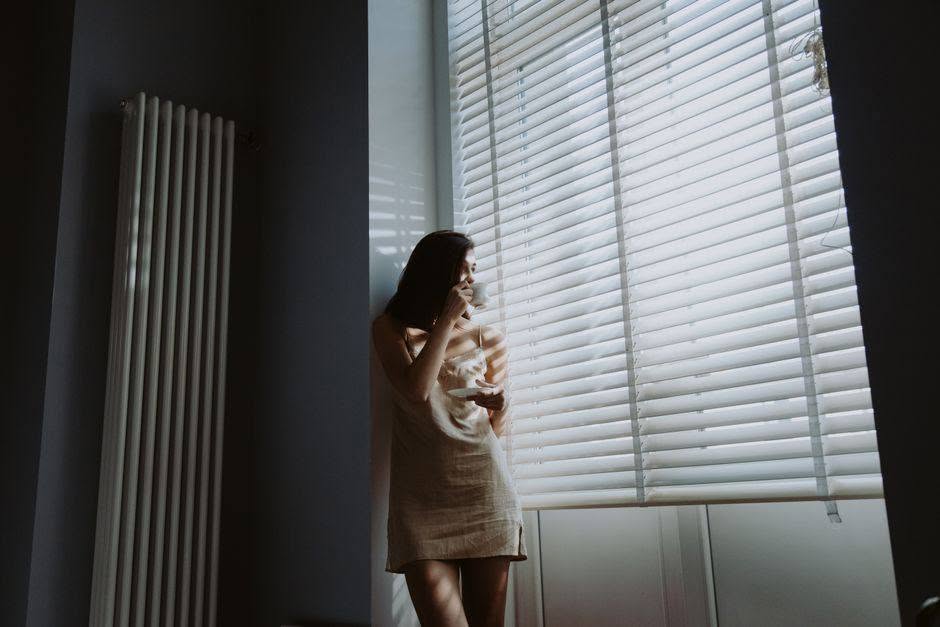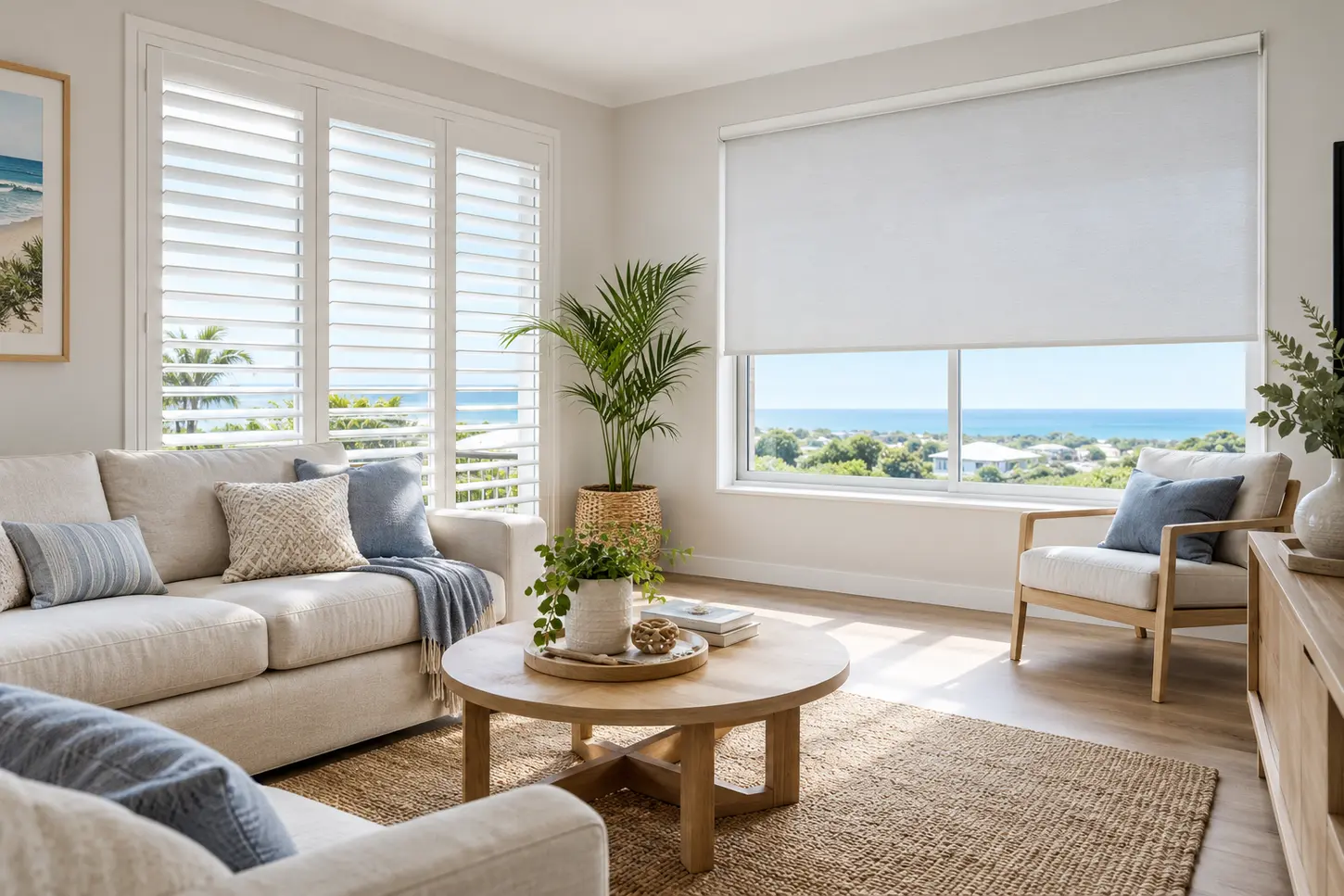

Choosing between plantation shutters and blinds is one of those decisions that sounds simple until you’re standing in front of a window wondering what to do. Both are popular window furnishing options across Australian homes, and both can help manage natural light, privacy and the overall look of a room — but they differ in construction, operation, maintenance and overall cost.
So, are plantation shutters worth choosing over conventional blinds? It depends on what you’re trying to achieve. For Gold Coast homeowners, that question involves a few local factors: bright subtropical sunlight, warm weather for much of the year, a design culture that leans coastal and relaxed, and the practical need to choose materials that suit each room.
There’s no single answer that applies to every room in every home. The better choice comes down to your budget, how you use the space, your design preferences and how much control over light and privacy actually matters day to day. In some rooms, plantation shutters make a lot of sense. In others, a well-chosen blind is the more practical call.
Below, we walk through the main differences between plantation shutters and blinds — cost, light control, privacy, airflow, maintenance, design and how each option performs room by room — so you can make an informed decision rather than simply going with what looks nice in a photo.
What Is the Difference Between Plantation Shutters and Blinds?
Before comparing them across specific factors, it helps to understand what each product is and how it works.
What Are Plantation Shutters?
Plantation shutters are framed window coverings with adjustable horizontal louvres (also known as blades), which give the product its distinctive look. The louvres tilt to regulate how much light enters a room, how much air can pass through an open window and how visible the interior is from outside.
Unlike most blinds, shutters are installed as a semi-permanent fixture. They sit within or against the window frame and are made to measure for each opening. Their solid panels and structured construction give rooms a more finished, architectural appearance.
Award Carpets Gold Coast offers two main material options: Fauxwood and natural timber. Each has its own care requirements and suits different rooms, and understanding what plantation shutters are — how the frame, louvres, stiles and tilt mechanism work together — makes the comparison with blinds much easier to follow.
What Are Blinds?
Blinds cover a window using fabric, slats or other movable materials that can be adjusted or retracted. The operating mechanism depends on the type — some roll, some fold, some tilt their slats and others traverse across the opening as vertical panels.
Common options include:
- Roller blinds — a single fabric panel that rolls up and down
- Blockout blinds — roller-style blinds in opaque fabric designed to reduce incoming light
- Sunscreen blinds — a mesh-style fabric that filters light and glare while retaining some of the view
- Double roller blinds — two fabrics fitted together, typically pairing a sunscreen layer with a blockout layer
- Venetian blinds — horizontal slats that tilt to adjust light and can be raised fully
- Vertical blinds — vertical louvres that traverse across larger openings such as sliding doors
- Roman blinds — a fabric panel that folds into horizontal pleats when raised, giving a softer, more decorative finish
Across these types, there’s a wide range of fabrics, colours, transparency levels and operating configurations, and each delivers a different degree of privacy and room darkening.
The Main Differences at a Glance
| Feature | Plantation Shutters | Blinds |
| Appearance | Structured, architectural finish | Styles ranging from streamlined to soft and decorative |
| Light control | Adjustable louvres | Depends on blind type and fabric |
| Privacy | Adjustable louvres, with possible gaps | Varies by material, design and installation |
| Room darkening | Specialised designs can reduce incoming light | Blockout blinds can provide strong room darkening |
| Maintenance | Generally straightforward dusting and cleaning | Depends on fabric, slats and mechanism |
| Child safety | No operating cords or chains | Corded designs must meet mandatory safety requirements; cordless options are available |
| Installation | Usually made to measure and fitted as a more permanent fixture | Available in a range of made-to-measure systems and configurations |
| Budget | Often a higher initial investment | Wide range of price points |
| Design flexibility | Frame, louvre and finish options | Extensive choice of fabrics, colours and operating styles |
| Best suited to | Homeowners prioritising architectural style and long-term use | Homeowners prioritising choice, flexibility and budget |
Treat this as a general comparison rather than an absolute rule. Exact performance depends on the product, installation, window dimensions and selected materials.
Plantation Shutters vs Blinds: Cost and Long-Term Value
Cost is usually the first thing people want to understand when weighing up shutters vs blinds. The honest answer is that both vary significantly in price depending on what you choose.
Are Plantation Shutters More Expensive Than Blinds?
Custom-made plantation shutters often require a larger initial investment than many blinds. The cost of plantation shutters vs blinds is shaped by several factors on the shutter side: material selection, window dimensions, the number of panels, the configuration (such as hinged, bi-fold or sliding) and installation. Because shutters are made to measure and fitted as a fixture, the price reflects that level of customisation.
Blinds cover a much broader range of price points. A standard blockout roller blind is generally a more affordable option for a typical window, while premium fabrics, motorised systems or complex configurations for large openings can also represent a meaningful investment.
Rather than relying on general category prices, the most useful approach is to compare itemised quotes for equivalent windows.
Do Plantation Shutters Save Money Over Time?
Long-term value depends on durability, maintenance, product quality and how long you intend to keep the property.
The case for shutters usually centres on their construction. A well-made, well-maintained shutter can remain in good condition for many years, while some blind fabrics and mechanisms may need replacing over time. Whether that adds up to a genuine saving depends on the specific products being compared and how the windows are used — so it’s best to weigh up likely durability in your rooms rather than expect a guaranteed lifespan or financial return.
Do Plantation Shutters Add Value to Your Home?
Plantation shutters have an architectural appearance, and coordinated window furnishings can improve how a property presents — whether you’re living in it, leasing it or preparing it for sale.
That said, buyer preferences vary, and a higher resale price isn’t guaranteed by any single fixture. Shutters tend to be most relevant to renovations, owner-occupied homes and properties where interior presentation is a priority.
Are Blinds Better for a Tight Budget?
If you’re furnishing multiple windows at once, blinds can be a practical way to cover the whole home without stretching the budget. They’re also well suited to rentals, investment properties and staged renovations, where flexibility and ease of replacement matter.
A less expensive blind can still be a quality solution when it’s chosen for the room’s actual needs — the right fabric in the right room often matters more than the price tag.
That said, if you’re planning to stay in the home, it’s worth looking at the full picture. Shutters may cost more at the start, but one product handles daytime light control and night-time privacy, there’s no fabric to replace and there are few moving parts to wear. Some homeowners start with shutters in the rooms that matter most and add more over time.
Light Control: Which Is Better, Plantation Shutters or Blinds?
Rather than labelling one as better, it’s more useful to look at how each manages daylight across the day.
How Plantation Shutters Control Natural Light
Tilting the louvres changes both how much light enters and the direction it travels. You can angle them upward to bounce soft light towards the ceiling, or close them further to reduce glare — all while the panels stay in position.
That balance between daylight and privacy is a big part of their appeal for street-facing windows and living areas, where you want a bright room without feeling on display.
How Different Blinds Control Light
Light control varies by blind type:
- Sunscreen blinds filter incoming light and reduce glare while keeping some of the outlook. The tighter the weave, the more privacy and glare reduction; the more open the weave, the more view.
- Light-filtering roller blinds soften daylight without blocking it, giving a diffused effect across the room.
- Blockout blinds use opaque fabric to substantially reduce incoming light, which is why they’re common in bedrooms and media rooms.
- Venetian blinds allow light adjustment by tilting the slats, similar in principle to shutter louvres.
Which Option Is Better for Bedrooms and Home Theatres?
Where reducing incoming light is the priority, blockout roller blinds are a strong option. Fitted well within the window recess, they can substantially reduce the light entering a room.
Specialised room-darkening shutters can also reduce light. Standard shutter designs, however, will still allow some light through the gaps around the louvres and frame.
Where shutters have the edge is adjustability. A blockout roller blind works largely as an up-or-down choice, while shutter louvres can be tilted just enough to let in a little morning light without giving up privacy, then closed again at night. Room-darkening shutters such as Fauxwood Night combine that flexibility with features designed to reduce light leakage.
Either way, it’s worth evaluating the complete installation — the product, the fit and the window itself — rather than assuming any product guarantees total darkness.
Privacy and Airflow: Which Window Covering Performs Better?
Plantation Shutters for Daytime Privacy
Angling the louvres can restrict direct sightlines into a room while still letting in some daylight and airflow. That makes shutters a practical choice for ground-floor and street-facing windows.
How private a room feels depends on the viewing angle, the louvre position and the lighting conditions inside and out. A partly angled louvre that works well during the day may not give the same result at night when interior lights are on — but closing the louvres fully gives considerably more privacy after dark, even though small gaps around the louvres and frame remain.
Blinds for Privacy at Different Times of Day
Privacy with blinds depends heavily on the fabric:
- Blockout fabrics offer strong privacy day and night because they don’t let light pass through.
- Sunscreen fabrics can provide useful daytime privacy when it’s brighter outside, but may provide less privacy at night when interior lights are on.
- Translucent or light-filtering fabrics sit somewhere in between, softening the view into the room without fully blocking it.
The position of the blind and the opacity of the fabric both affect the result. A double roller can give you a sunscreen layer for daytime and a blockout layer for night. With shutters, the same panels do both jobs: angle the louvres during the day and close them at night.
Can Plantation Shutters Improve Airflow?
With the window open, tilting the louvres can let air pass through while the shutter panels remain closed — a handy option on warm Gold Coast days when you want a breeze without opening up the whole room.
It’s worth being clear that shutters don’t create ventilation themselves; airflow depends on the window being open and on outdoor conditions. When a blind is raised, the opening is largely clear, so airflow is mostly a matter of whether you’re happy to give up privacy or shade at the same time. Shutters offer a similar option when you want the full opening — hinged and bi-fold panels can be swung completely clear of the window.
Child Safety: Shutters vs Corded Blinds
Why Blind Cords Are a Safety Concern
Loose cords and chains on blinds and curtains can pose a strangulation risk to babies and young children. For that reason, Australia has mandatory safety requirements covering both the supply and the installation of corded internal window coverings, including measures such as cord guides or cleats that keep cords secured, and safety labelling.
Compliant corded blinds can be used safely when they’re installed and maintained correctly, and cordless and motorised blind options are also available. Cords do need ongoing attention, though. A cord guide that has come loose, or a cot or couch moved closer to a window, can change the risk.
Plantation Shutters Have No Cords or Chains
Plantation shutters are operated by hand. The louvres are tilted directly or with a tilt rod, and the panels open and close much like a cupboard door. There are no operating cords or chains to secure, check or keep out of reach.
For families with young children, households with grandchildren who visit and landlords furnishing a property for future tenants, that cord-free design takes one consideration off the list. It’s also one reason Fauxwood Night is worth considering for children’s rooms, where both darkness and a cord-free design matter. As with any window, it’s still sensible to keep climbable furniture away from it.
Appearance and Interior Design: Shutters vs Blinds
Why Plantation Shutters Suit Coastal and Contemporary Homes
Plantation shutters bring clean lines, a framed appearance and architectural character. Rather than hanging in front of the window, they read as part of it.
They sit comfortably within coastal, Hamptons, contemporary, minimalist and traditional interiors. Finish and louvre proportions shape the final look — wider louvres in a white painted finish feel fresh and open, while a stained timber finish brings more warmth and texture.
Shutters also tend to suit an interior as it changes. A neutral painted or timber finish can stay put through new furniture, soft furnishings and wall colours, whereas a fabric chosen to match one colour scheme may feel out of place after the next update.
Why Blinds Offer More Style and Fabric Choices
Where shutters offer consistency, blinds offer variety. The range of colours, patterns, fabrics and textures is considerably broader.
A streamlined roller blind in a neutral fabric can sit quietly in a room. A Roman blind adds softness and a more decorative touch. Venetian blinds give a structured, layered look. Chosen well, blinds can complement existing furnishings without becoming the dominant feature.
Which Window Covering Works Best With Your Flooring?
Window furnishings and flooring are two of the most visible surfaces in a room, so it makes sense to think about them together.
Light-coloured shutters tend to pair easily with timber-look flooring, neutral carpet or contemporary hybrid flooring, creating a clean, cohesive feel. Textured or coloured blinds can pick up tones in existing floor finishes — a linen-look fabric with oak-tone hybrid, for example, or a natural Roman blind above warm-toned carpet.
Because Award Carpets Gold Coast supplies flooring alongside plantation shutters, homeowners can consider both at the same time during a renovation or new build, rather than making two separate decisions months apart.
Maintenance, Cleaning and Durability
Are Plantation Shutters Easy to Clean?
Routine care generally involves dusting the louvres, frames and panel edges with a soft cloth or duster. For a more thorough clean, a suitable soft cloth — lightly dampened where the manufacturer allows — is usually enough. Always follow the care instructions for your specific product.
Fauxwood and natural timber have different needs. Fauxwood is typically easier to wipe down, while natural timber should be kept away from excess moisture. Not every Fauxwood product is waterproof or suited to every wet area, so check the specifications before assuming it can go anywhere.
There’s also no fabric to fade, stain or hold onto dust, and no cords, chains or roller mechanisms to wear out — which keeps ongoing maintenance fairly simple.
How Much Maintenance Do Blinds Need?
Cleaning requirements vary by material and construction. Venetian slats need dusting one by one, which is simple but can be time-consuming on larger windows. Many fabric blinds can be gently vacuumed or spot-cleaned, while some fabrics need specialist cleaning.
Cords, chains, tracks and other operating mechanisms may also need attention over time, particularly on blinds that are raised and lowered every day.
Which Option Lasts Longer?
Lifespan depends on material quality, installation, sunlight exposure, humidity and everyday use — so it isn’t accurate to say all shutters outlast all blinds.
Shutters use a fixed-panel construction with relatively few moving parts, which can work in their favour. Blinds rely on fabrics and mechanisms that vary widely in quality. A well-made blind that’s properly installed and cared for can perform well for many years, just as a quality shutter can.
Plantation Shutters vs Blinds in the Gold Coast Climate
Managing Bright Sunlight and Glare
Gold Coast homes can receive strong sunlight for much of the year, particularly through north- and west-facing windows. Rooms that cop the morning or afternoon sun are where window coverings tend to work hardest.
Shutters let you angle the louvres to deflect direct light and cut glare without closing off the room. Sunscreen blinds filter glare while keeping some of the view, and blockout blinds can shut out the light entirely when needed.
Keep in mind that indoor window coverings have limitations when it comes to heat. By the time sunlight reaches an internal shutter or blind, it has already passed through the glass, so internal coverings can only do so much. Eaves, awnings, glazing and other external shading generally play a bigger role in keeping heat out.
Choosing Window Furnishings for Humid Conditions
Humidity is a regular part of Gold Coast life, so material choice matters more than product category.
Natural timber and Fauxwood have different care requirements: timber is generally better suited to drier rooms, while Fauxwood products are often chosen for areas with more moisture. Blind fabrics and mechanisms vary in the same way. Before choosing anything for bathrooms, laundries or other moisture-prone areas, check the manufacturer’s specifications for that product.
What Should Coastal Homeowners Consider?
Coastal homes bring a few extra considerations: sunlight exposure, ventilation, cleaning requirements and material selection.
If you’re close to the coast, it’s worth reviewing the manufacturer’s recommendations for the specific product and where it will be installed. Claims about UV resistance, moisture performance and durability should always be checked against the product’s actual specifications rather than assumed from the category.
Hardware is worth asking about too. In salt-air locations close to the beach — such as Palm Beach, Broadbeach or Surfers Paradise — metal hinges, pins and fixings can corrode over time if they aren’t suited to coastal conditions. Stainless steel hardware generally resists corrosion better than standard steel, and marine-grade 316 stainless is typically more resistant to salt exposure than 304 grade. If you live near the coast, ask what hardware is used and whether coastal-grade options are available for your installation.
Which Is Better for Each Room in Your Home?
Plantation Shutters vs Blinds for Living Rooms
Living rooms are where the plantation shutters vs blinds decision is most visible. Shutters give the room a consistent architectural finish across multiple windows, while roller, sunscreen and Roman blinds offer more flexibility in look and function.
Think about natural light, views and privacy — and how you want the room to feel. If the living area is street-facing and used all day, adjustable louvres may suit. If the view is the priority, a sunscreen blind that keeps the outlook while cutting glare may be the better fit.
Plantation Shutters vs Blockout Blinds for Bedrooms
Bedrooms usually come down to a trade-off between everyday privacy and light adjustment on one hand, and room darkening on the other.
Blockout blinds are a strong choice where darkness matters most. For homeowners who prefer the look of shutters in the bedroom, Fauxwood Night shutters are designed to reduce incoming light, with grooved louvres and grooved top and bottom rails among their light-reducing features.
If you need substantial darkness — for shift work, young children or light sleepers — assess the complete window covering system, including how the product fits the window, before deciding.
Best Window Coverings for Kitchens and Bathrooms
Kitchens and bathrooms deal with moisture, heat, cooking residue and frequent cleaning, so material suitability comes first.
Easy-care Fauxwood shutters can work well where wipe-clean surfaces are a priority, with no fabric to absorb cooking residue. Blinds can also suit these rooms, provided the fabric and mechanism are designed for the conditions — avoid fabrics that hold onto cooking residue or can’t be cleaned easily.
Whatever you choose, confirm the product’s wet-area suitability before installation.
Plantation Shutters vs Blinds for Home Offices
In a home office, the main concerns are glare on screens, daytime privacy and enough natural light to work comfortably.
Adjustable louvres can redirect light up and away from a monitor while keeping the room bright, and the angle can be fine-tuned as the sun moves across the day. Sunscreen or light-filtering blinds can soften glare while keeping an outlook. Window orientation and screen placement both influence the decision — a window behind a screen creates different problems from one beside it.
Which Is Better for Sliding Doors and Large Windows?
The size and configuration of an opening affects which products are suitable. Shutters can be configured as hinged, bi-fold, sliding or fixed panels, while vertical blinds and panel glide blinds are common choices for wide openings and sliding doors.
Consider how often the door is used, how easy it needs to be to walk through and how much space is available for panels or blinds to stack or swing. Bi-fold and sliding shutter panels can stack to the side to keep the doorway clear. A professional measure is the most reliable way to work out which system suits the opening.
Best Options for Rental and Investment Properties
For rental and investment properties, compare upfront costs, cleaning requirements, durability and how easily the window furnishings can be updated between tenancies.
Blinds often suit budget-conscious upgrades and are simple to replace individually. Shutters may appeal to owners seeking a more integrated finish that holds up between tenancies — wipe-clean surfaces, no fabric to stain or tear and no cords or chains to secure. For properties likely to suit families with young children, that cord-free design can be a meaningful consideration. Neither is the best choice for every rental — it depends on the property and what the owner is aiming for.
Types of Plantation Shutters to Consider
Fauxwood Plantation Shutters
Fauxwood shutters are designed to recreate the appearance of painted timber with easy-care, practical construction. They suit busy households where simple cleaning is a priority.
The Fauxwood range at Award Carpets Gold Coast includes three options. Fauxwood Eco is termite proof and VOC compliant, with insulating properties and a construction designed to resist warping, peeling, splitting and shrinking. Fauxwood Eco Air offers a versatile option for bedrooms, living areas and investment properties. Fauxwood Eco Elite is designed for greater flexibility across different window configurations, including larger window applications.
Because features and suitability differ between products, it’s worth checking the individual specifications for the room you have in mind — particularly for wet areas.
Timber Plantation Shutters
Genuine timber brings natural grain and warmth that engineered materials approximate but don’t fully replicate, which is why timber shutters are often chosen for premium interiors.
The Timber Eco range is made from Paulownia, a lightweight timber, and is available in painted, stained and lacquered finishes. Timber is generally best suited to drier rooms such as living areas, bedrooms and home offices.
Room-Darkening Plantation Shutters
Standard shutters let some light in around the louvre edges and frame. Room-darkening designs use specialised louvres and rails to help reduce that light leakage.
Fauxwood Night features grooved louvres and grooved top and bottom rails, along with other light-reducing details, making it an option for bedrooms, children’s rooms and home theatres. Even so, room-darkening shutters aren’t necessarily equivalent to a complete blackout system, so it’s worth discussing your expectations at the measure-and-quote stage.
How Do You Choose the Right Plantation Shutter?
A few factors to compare:
- Material — Fauxwood or timber, and which product within each range
- Finish — painted, stained or lacquered, and the colour or tone
- Room requirements — moisture, cleaning frequency and light-reduction needs
- Window dimensions and configuration — panel numbers, frame style and how the window opens
- Budget — across the full supply and installation, not just the product
Each window is worth considering individually, since what suits a living room may not suit a west-facing bedroom or a bathroom. The full range of plantation shutters Gold Coast homeowners can choose from covers Fauxwood Eco, Eco Air, Eco Elite, Night and Timber Eco.
Can You Combine Plantation Shutters and Blinds in the Same Home?
You don’t need to choose one window treatment for every room. Many homes use a mix, matching each product to the space.
A common approach is to use shutters in prominent living areas, where their architectural finish makes the biggest impression, and blinds in bedrooms where specific light-filtering or blockout performance is needed. Sunscreen blinds can be a good fit in rooms where you want to manage glare but keep the view.
Combining products can also help balance aesthetics, budget and function across the whole property. Rather than treating it as an all-or-nothing decision, work through the home room by room.
How to Choose Between Plantation Shutters and Blinds
Choose Plantation Shutters If…
- You prefer a structured, architectural window finish
- You want adjustable louvres for managing light, privacy and airflow
- You want one product that handles daytime light control and night-time privacy
- You have young children, or grandchildren who visit, and want window coverings without cords or chains
- You’re planning a long-term renovation or new home
- You prefer a fixed-looking window furnishing with straightforward cleaning requirements
- You want to explore Fauxwood or natural timber finishes — the plantation shutters Gold Coast range includes both
Choose Blinds If…
- Your upfront budget is a major consideration
- You want a wide selection of colours, patterns and fabrics
- You need a specific sunscreen, light-filtering or blockout fabric
- You prefer a window treatment that can be raised out of the way
- You need a practical solution for a particular window or rental property
What Should You Ask Before Ordering?
- What are the total supply and installation costs?
- Which material and finish are suitable for the room?
- How much light will enter around the product?
- What maintenance is required?
- Which operating or panel configuration suits the window?
- If you’re close to the beach, what grade of hardware is used for hinges and fixings?
- What product warranty and care instructions apply?
- When can the product be measured, manufactured and installed?
Explore Plantation Shutters at Award Carpets Gold Coast
Award Carpets Gold Coast is a family-owned business that has been supplying and installing flooring on the Gold Coast for over 30 years, and now also supplies plantation shutters. The range includes Fauxwood Eco, Fauxwood Eco Air, Fauxwood Eco Elite, Fauxwood Night and Timber Eco shutters.
If shutters feel like the right fit for some or all of your windows, it helps to compare the options based on each room’s requirements, your preferred look and your budget. And if new floors are also on the cards, coordinating flooring and window furnishings can help you achieve a consistent finish across a renovation or new build.
Not sure whether plantation shutters are right for your home? Explore the plantation shutters Gold Coast range and speak with the Award Carpets Gold Coast team about options suited to your windows, interior style and budget — or arrange a free measure and quote to get accurate pricing for your windows.
Frequently Asked Questions
Are plantation shutters better than blinds?
Neither is universally better. Plantation shutters offer a structured finish and adjustable louvres, while blinds provide a broader selection of fabrics, operating styles and light-control options. The right choice depends on the room, your budget and what you need the window covering to do.
Are plantation shutters more expensive than blinds?
Shutters often cost more upfront, depending on the material, size and configuration. Blind prices also vary widely, from simple roller blinds to premium systems, so the most reliable comparison is between itemised quotes for equivalent windows.
Do plantation shutters block out more light than blinds?
It depends on the products being compared. Standard shutters let some light in around the louvres and frame. Specialised room-darkening shutters reduce light leakage, but blockout blinds are often a strong choice when darkness is the priority.
Are plantation shutters safer than blinds for children?
Plantation shutters have no operating cords or chains, so they don’t carry the cord-related strangulation risk associated with some blinds and curtains. Corded blinds supplied and installed in Australia must meet mandatory safety requirements, and cordless blind options are available. For families with young children, though, a cord-free design means one less thing to secure and check.
Are plantation shutters suitable for Gold Coast homes?
Plantation shutters suit many Gold Coast homes and interior styles. The key is selecting the right material for each room — taking into account humidity, sun exposure and the manufacturer’s recommendations — rather than assuming one material suits every space.
Are Fauxwood plantation shutters better than timber shutters?
They suit different priorities. Fauxwood may appeal to homeowners prioritising easy care and practicality, while natural timber offers authentic wood character and warmth. The best option depends on the room and the finish you’re after.
Which is easier to maintain, shutters or blinds?
Smooth shutter surfaces are generally straightforward to dust and wipe, with no cords, chains or fabric to look after. Blind maintenance depends on the fabric, slats and operating mechanism — some fabrics are easy to spot-clean, while others need specialist cleaning.
Can plantation shutters and blinds be installed in the same house?
Yes. Many homeowners use shutters in living areas and blinds in bedrooms or home offices, balancing appearance, privacy, light control and budget across different rooms.
Do plantation shutters suit modern and coastal interiors?
Yes. Their clean lines and range of finishes can complement coastal, Hamptons, contemporary and traditional interiors. A crisp white finish reads very differently from a stained timber, so the finish you choose shapes how they sit within the room.
Planning New Floors and Shutters With Award Carpets Gold Coast
If you’re renovating, building or refreshing a property, window furnishings and flooring are often decided around the same time — and it’s easier to get a cohesive result when they’re considered together. A light Fauxwood shutter alongside timber-look hybrid, or a stained Timber Eco shutter with warm-toned carpet, can make a room feel finished rather than pieced together.
It also helps to come to the conversation with a few details: which rooms you’re furnishing, which way the windows face, whether any rooms need extra darkness and which areas deal with moisture. With that information, the Award Carpets Gold Coast team can talk you through the shutter options and configurations that suit each window, alongside the flooring you’re considering. When you’re ready, book a free measure and quote to move from research to a decision.