

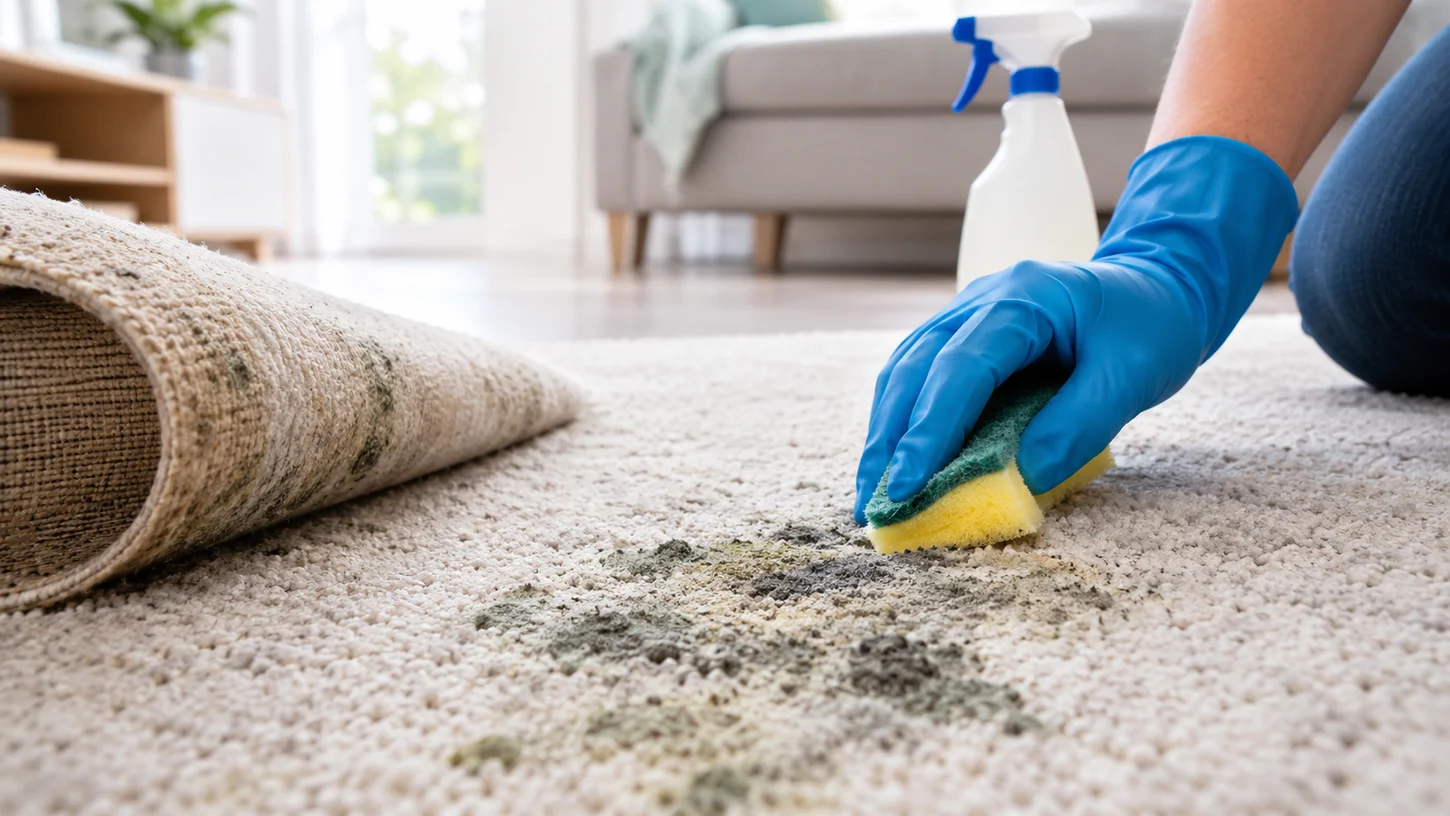

Mould in carpet is one of those problems that tends to announce itself with a smell before you ever see it. You walk into a room, notice something damp and earthy in the air, and start sniffing around the skirting boards trying to work out where it’s coming from. Sooner or later, you pull back a rug or shift a lounge and find the patch you were hoping wasn’t there.
On the Gold Coast, this is a more common issue than most people expect. Our humidity sits high for large parts of the year, summer storms roll through with plenty of water behind them, and homes here are often built with airflow in mind rather than sealed-up dryness. Add carpet into the mix, which is soft, absorbent and sits right where moisture collects, and you’ve got conditions mould genuinely likes.
The good news is that a lot of carpet mould problems can be dealt with at home, provided you catch them early and deal with the moisture that caused them. The less-good news is that some of them can’t, and knowing which is which will save you a lot of scrubbing.
This guide walks through how to get rid of mould out of carpet, what causes it in the first place, how to tell whether the damage runs deeper than the surface, and when replacing the carpet is the more sensible call. At Award Carpets Gold Coast, we’ve spent more than 30 years supplying and installing flooring across the region, and we’ve seen plenty of carpet come to the end of its life this exact way.
Can You Really Get Mould Out of Carpet?
Sometimes yes, sometimes no. It depends on how far the mould has spread, how long it’s been there, what caused the moisture, and whether it’s reached the underlay and subfloor beneath.
Surface mould on a small, recently affected patch of dry-ish carpet is often manageable. Mould that has soaked through into the backing and underlay is a very different job.
Why Mould Grows in Carpet
Mould needs three things: moisture, a food source, and time. Carpet supplies two of them without any help at all. The fibres, dust, skin cells, pet hair and general household debris that settle into a pile make an excellent food source, and the pile itself holds moisture close to the floor where airflow is weakest.
Add water — from a spill, a leak, or just weeks of humid air — and spores that are already floating around your home have everything they need. In warm conditions, growth can begin within 24 to 48 hours.
How Carpet Traps Moisture, Dust and Organic Matter
Carpet works a bit like a filter. Fine particles drift down through the pile and settle at the base, where vacuuming reaches them least effectively. Over years, that builds up into a layer of organic material sitting at the bottom of the carpet, right against the backing.
Moisture behaves the same way. Liquid travels down through the fibres, through the backing, and into the underlay, which is designed to be soft and absorbent. Once it’s in there, it dries slowly — and the top of the carpet can feel perfectly dry while the layer underneath is still damp.
When Mould Can Be Removed From Carpet
Cleaning is usually worth attempting when:
- The affected area is small and clearly defined, roughly the size of a dinner plate or smaller
- The moisture came from clean water, such as a spilled drink or a small tap leak
- The carpet was wet for a short period, ideally under 48 hours
- The underlay and subfloor feel dry
- There’s no strong musty smell lingering in the room
- The mould appears on the surface of the pile rather than growing through from beneath
When Mouldy Carpet Needs to Be Replaced
Replacement becomes the practical option when:
- Mould covers a large area or appears in multiple spots around the room
- The carpet has been wet for several days
- Water came from a sewage backup, floodwater, or any contaminated source
- Mould has grown into the underlay or onto the subfloor
- The musty smell returns after cleaning
- The problem has come back more than once in the same spot
- The carpet is old and already showing wear
| Situation | Likely outcome |
| Small surface patch, clean water, dried within 48 hours | Cleaning usually works |
| Patch larger than around 1m², clean water | Professional assessment recommended |
| Mould visible on the carpet backing or underlay | Underlay replacement, often carpet too |
| Floodwater or contaminated water | Replacement |
| Recurring mould in the same location | Fix the moisture source, then replace |
| Musty smell that survives cleaning | Contamination remains — replacement likely |
Why Removing Surface Mould Does Not Always Solve the Problem
This is the part people most often get caught by. You clean the visible spots, the carpet looks fine, and a fortnight later the smell is back.
That’s because what you can see on top is frequently the smallest part of the growth. If moisture reached the underlay, mould is growing there too, out of sight and undisturbed. Cleaning the surface removes the evidence without removing the cause, and the colony underneath simply keeps going.
The same applies if you haven’t fixed whatever made the carpet wet in the first place. A leaking pipe, a failed window seal or a subfloor drainage issue will keep feeding the problem no matter how well you clean.
What Causes Mould to Grow in Carpet?
Nearly every case of carpet mould traces back to moisture that stayed too long. Working out which source is responsible matters, because it determines whether the problem is a one-off or something that will keep returning.
Water Leaks and Flooding
Burst pipes, leaking washing machine hoses, failed hot water systems, blocked gutters and storm water entering under a door are all common culprits. Leaks under kitchen sinks and behind laundry cabinetry are especially sneaky because they wet the floor slowly and quietly, often for weeks before anyone notices.
Spills and Accidental Water Damage
A knocked-over drink seems minor, and usually is — if you blot it up properly. The trouble comes when liquid soaks past the surface and only the top gets dried. Pet accidents deserve particular attention, since they add organic matter along with the moisture.
High Indoor Humidity
You don’t need a leak for mould to grow. When indoor humidity sits above roughly 60% for extended periods, carpet fibres absorb moisture straight out of the air. Through a Gold Coast summer, that’s an entirely realistic scenario in a closed-up house.
Poor Ventilation
Rooms that stay shut — spare bedrooms, home offices, granny flats, rooms behind heavy curtains — hold damp air in place. Without air movement, moisture settles into soft surfaces and stays there. Furniture pushed hard against walls creates the same effect in miniature.
Condensation and Damp Rooms
When warm, moist air meets a cooler surface, it condenses. That water runs down windows and walls and collects at floor level, which is exactly where your carpet is. Bedrooms with air conditioning running against humid outdoor air are a frequent example.
Wet Shoes and Clothing
Thongs after a beach walk, gym gear dropped on the bedroom floor, wet swimmers, umbrellas left to drip in a hallway. None of these will ruin a carpet on their own, but repeated in the same spot over months, they create a permanently damp patch.
Carpet Installed Over Damp Flooring
Concrete slabs hold a surprising amount of moisture, and new slabs need proper curing time before anything goes over them. Laying carpet on a slab that hasn’t dried, or on a subfloor with rising damp, traps moisture between the floor and the carpet backing with nowhere to go. This is one reason correct preparation during flooring installation matters as much as the flooring itself.
Previous Water Damage That Was Never Properly Dried
Old flood or leak damage that got a quick surface dry and no more can leave mould living quietly in the underlay for years. Buyers of older homes sometimes inherit this without knowing, and only discover it when they lift the carpet during a renovation.
How to Tell If Your Carpet Has Mould
Mould on carpet doesn’t always look the way people expect. Here’s what to watch for.
Musty or Damp Smells
The smell almost always comes first. It’s earthy, stale, slightly sweet — the smell of an old caravan or a cupboard that hasn’t been opened in a year. If a room smells musty and clears up when you open the windows, then returns when you close them, something in that room is holding moisture.
Black, Green, White or Brown Spots
Visible growth can appear in a range of colours depending on the type and how established it is.
| Appearance | What it often indicates |
| Black or very dark green spots | Well-established growth, frequently linked to prolonged wetness |
| Green or blue-green patches | Common household moulds, often on damp organic material |
| White, fuzzy or powdery film | Early-stage growth or mildew on the surface |
| Brown or yellowish staining | Older growth, or water staining with growth alongside it |
| Grey-green with a slimy texture | Usually indicates the area is still actively wet |
Colour alone doesn’t tell you how serious the problem is. The size of the affected area and how deep the moisture went matter far more.
Discolouration and Staining
Look for patches that don’t match the surrounding carpet — dull areas, rings, dark edges around the perimeter of a spill. Mould-related discolouration often has an irregular, spreading shape rather than a clean outline.
Carpet That Feels Damp or Wet
Press your palm firmly into the pile in the suspect area and hold it there for a few seconds. Compare it with a section of carpet across the room. Cool and damp against dry and room-temperature is a clear signal.
Mould Growing Beneath the Carpet
If you can lift a corner safely — near a doorway or along a wall — check the underside of the carpet backing and the top of the carpet underlay. Growth here looks like dark speckling or a chalky bloom, and the smell will be noticeably stronger than at surface level.
Increased Mould Around Skirting Boards and Walls
Mould on skirting boards, on the lower section of walls, or on the back of furniture placed against an external wall suggests a room-wide moisture issue rather than a carpet-specific one. Cleaning the carpet alone won’t resolve that.
Signs of Ongoing Moisture Problems
- Condensation forming regularly on windows
- Paint bubbling or peeling near the floor
- Skirting boards that feel soft or swollen
- A damp patch that reappears after drying
- Rusting on metal fixtures near floor level
- Timber flooring in adjoining rooms cupping or lifting
Is Mouldy Carpet Dangerous?
Mould in the home is worth taking seriously, though it’s also worth keeping in proportion. A small patch you find early and deal with promptly is a manageable household job, not an emergency.
Why Indoor Mould Should Be Taken Seriously
Mould reproduces by releasing spores into the air. In a well-ventilated home with small amounts of growth, spore levels stay low. In a closed room with an established colony in the carpet or underlay, those levels climb, and every time someone walks across the floor, more spores are pushed into the air you’re breathing.
Possible Effects of Exposure to Mould
Reactions vary considerably between individuals. Commonly reported effects include:
- Nasal congestion, sneezing and a runny nose
- Irritated or watery eyes
- Coughing or throat irritation
- Skin irritation
- Worsening of existing respiratory conditions
- Headaches or a general feeling of stuffiness that eases when you leave the house
If anyone in the household is experiencing ongoing symptoms they think might be related to damp or mould in the home, that’s a conversation to have with a doctor rather than something to self-assess.
Why Disturbing Mould Can Spread Spores
Vacuuming, scrubbing and pulling up carpet all agitate mould and send spores airborne. This is why the way you approach cleaning matters — a vigorous dry-scrub of a mouldy patch can distribute the problem across an entire room in a few minutes.
It’s also why ventilation and protective gear aren’t optional extras. You want spores heading out the window, not into your lungs.
People Who May Be More Sensitive to Indoor Mould
Some people react more strongly than others, including:
- Infants and young children
- Older adults
- People with asthma or other respiratory conditions
- People with allergies
- Anyone with a weakened immune system
If someone in these groups lives in the home, it’s sensible to be more cautious about DIY cleaning and to consider getting the work done professionally.
When Professional Mould Remediation May Be Necessary
Bring in a specialist when the affected area is large, when mould has spread to walls or ceilings, when the source is contaminated water, when growth keeps returning, or when a household member is particularly sensitive. Remediation specialists work differently to carpet cleaners — they contain the area, control airflow and address the building fabric, not just the floor covering.
What You Need Before Cleaning Mould From Carpet
Get everything together before you start. Halfway through a cleaning job is a bad time to go looking for gloves.
Protective Gloves and Other Personal Protective Equipment
At minimum: rubber or disposable gloves, a well-fitting P2 mask, and safety glasses. Wear clothes you can wash straight afterwards, and wash them separately on a hot cycle when you’re done.
Vacuum Cleaner and Suitable Attachments
A vacuum with a HEPA filter is strongly preferred, because a standard filter can pass fine spores straight through the machine and back into the room. Use an upholstery or crevice attachment for controlled work on a small area. Empty the vacuum outside afterwards and bag the contents.
Soft-Bristled Brush
A soft brush lets you work cleaning solution into the pile without tearing fibres or driving mould deeper into the backing. Avoid stiff wire brushes entirely.
Clean Cloths or Paper Towels
You’ll need more than you think. White cloths are useful because they let you see what you’re lifting out of the carpet, and they won’t transfer dye. Dispose of used paper towels in a sealed bag.
Appropriate Carpet Cleaning Products
Choose products labelled as safe for your carpet type. Check what the manufacturer recommends before you buy anything, particularly with wool or wool-blend carpet, which is far less tolerant of harsh chemicals than synthetics.
Fan, Dehumidifier or Other Drying Equipment
Drying is the step people rush, and it’s the one that decides whether the mould comes back. A pedestal fan, a dehumidifier, or both, running for a solid stretch after cleaning, does more for the outcome than any cleaning product.
Why Good Ventilation Is Important
Open windows and doors before you start and keep them open throughout. Ventilation dilutes airborne spores, carries moisture out of the room, and speeds up drying. If the weather won’t allow open windows, run a fan pointed towards an open doorway and use a dehumidifier in the room.
How to Get Rid of Mould Out of Carpet Step by Step
Here’s the full process for carpet mould removal on a small, contained area.
Step 1: Identify and Fix the Moisture Source
Nothing else in this list matters if you skip this. Find where the water came from and stop it. That might mean a plumber for a leaking pipe, a roofer for a gutter issue, a new door seal, or simply changing where wet items get dropped.
If the source is general humidity rather than a specific leak, the fix is ongoing humidity management rather than a one-off repair.
Step 2: Isolate the Affected Area
Move furniture out of the room, or at least well clear of the patch. Take up rugs. Keep children and pets out of the room while you work, and close internal doors so airborne spores don’t travel through the rest of the house.
Step 3: Improve Ventilation
Open external windows and doors. Set up a fan so it moves air from the room towards the outside rather than blowing across the mould and into the hallway. If you’re using a dehumidifier, position it in the room and let it run.
Step 4: Remove Loose Surface Contamination Carefully
Vacuum the affected area slowly with a HEPA vacuum, using gentle passes rather than aggressive back-and-forth scrubbing. Work from the outside of the patch inwards so you’re not dragging contamination into clean carpet. Empty and clean the vacuum outdoors immediately afterwards.
Skip this step if the carpet is still wet — vacuum once it’s dry, or use a wet extraction machine instead.
Step 5: Apply a Suitable Carpet-Safe Cleaning Solution
Test your chosen product on a hidden section of carpet first, such as inside a wardrobe. Wait, check for colour change or fibre damage, then proceed.
Apply the solution to the affected area. You want it damp, not saturated — adding a lot of water to a mould problem is counterproductive. Spraying gives you better control than pouring.
Step 6: Gently Clean the Affected Area
Work the solution into the pile with your soft brush using light circular motions. Let it sit for the time stated on the product label, usually five to ten minutes. Resist the urge to scrub hard; aggressive scrubbing damages fibres and pushes mould into the backing where you can’t reach it.
Step 7: Rinse or Extract Residue Where Appropriate
Blot the area with clean cloths, pressing firmly and replacing them as they pick up dirt. If the product requires rinsing, use a barely-damp cloth and blot rather than rinsing with water. A wet-dry vacuum or carpet extractor is ideal here because it pulls moisture back out rather than leaving it behind.
Step 8: Dry the Carpet Completely
This is the most important step in the whole process. Run fans directly on the area, keep the dehumidifier going, and maintain ventilation for at least 24 to 48 hours. Lift a corner of the carpet if you can to let air reach the underlay.
Check the carpet with your hand periodically. It should feel completely dry to the touch, all the way down to the base of the pile, before you put furniture back.
Step 9: Inspect the Carpet Again
Once dry, look closely at the area under good light and give it a proper smell test. Look for returning discolouration, remaining spots, or any lingering musty odour. Check again after a week — problems that are going to come back usually do so within the first fortnight.
Step 10: Repeat Cleaning or Arrange Professional Treatment When Needed
A second treatment is reasonable if there’s slight improvement but not full resolution. If two attempts don’t fix it, stop and get professional advice. Repeated heavy cleaning of the same patch will wear the carpet out without solving the underlying problem.
What Can You Use to Remove Mould From Carpet?
There’s no single product that suits every carpet or every situation. Here’s how the common options compare.
| Option | Best suited to | Things to consider |
| Commercial mould and mildew carpet cleaners | Visible mould on synthetic carpet | Check the label matches your fibre type |
| Mild detergent solution | Light surface marks, early growth | Gentle, but limited effectiveness on established mould |
| White vinegar solution | Small patches, mild odour | Can affect some fibres and dyes; never saturate the carpet base |
| Bicarbonate of soda | Odour absorption after cleaning | Deodorises rather than kills mould |
| Bleach-based products | Very limited use on carpet | High risk of permanent colour loss |
| Professional treatment | Larger or recurring problems | Includes proper extraction and drying |
Commercial Carpet Mould and Mildew Cleaners
Purpose-made products are generally the most reliable choice because they’re formulated for carpet fibres and usually include an antimicrobial component. Read the label to confirm it suits your carpet type, and follow the dilution and dwell time instructions rather than improvising.
Mild Detergent Solutions
A small amount of gentle detergent in warm water handles light surface marks and is about as low-risk as cleaning gets. It won’t do much against established mould, but it’s a sensible starting point for something you’ve caught very early.
Vinegar and Other Household Remedies
White vinegar is the most commonly suggested home remedy for how to get mould out of carpet naturally. It has some effect on certain surface moulds and helps with odour, and a diluted solution is worth trying on a small, mild patch.
Its limits are worth knowing. It’s less effective on established growth, it does nothing for mould in the underlay, and it can affect the colour or texture of some fibres — wool in particular. Test first, always.
There’s one more caution worth taking seriously with vinegar: don’t saturate the carpet with it. Most tufted carpet is held together by a latex adhesive between the primary and secondary backing, and repeated soaking with an acidic solution can break that adhesive down over time, leading to delamination where the backing separates from the carpet. Some manufacturers also advise that acidic solutions may affect factory-applied stain-resistance treatments.
The practical version: use a diluted solution, apply it as a light mist rather than pouring, keep it in the pile rather than driving it down to the base, and blot it back out. Vinegar used sparingly on the surface is low risk. Vinegar poured onto carpet until it’s soaked through is not.
Bicarbonate of soda is useful in a different way. Sprinkled on dry carpet and vacuumed off after several hours, it absorbs odour well, but it doesn’t kill mould and shouldn’t be relied on as a treatment.
Why You Should Check the Carpet Manufacturer’s Cleaning Recommendations
Different fibres tolerate different things. Wool is sensitive to alkaline cleaners and high heat. Nylon and polyester handle a wider range of products. Solution-dyed fibres resist colour loss better than others. Triexta carpet has its own cleaning characteristics that differ again.
Using the wrong product can void a warranty as well as damage the carpet, so the manufacturer’s care guide is worth five minutes of your time before you start.
Why Strong Chemicals Can Damage Carpet Fibres
Harsh chemicals can strip protective treatments, break down fibres, cause permanent colour change, and leave residues that attract dirt and make the area look grubby within weeks. Damage of this kind usually can’t be reversed, and a bleached patch in the middle of a room often looks worse than the mould did.
Why You Should Never Mix Cleaning Chemicals
Combining cleaning products — particularly bleach-based cleaners with ammonia-based ones — can produce dangerous fumes. Use one product at a time, rinse thoroughly between different treatments, and keep the room ventilated throughout.
How to Remove Mould Smell From Carpet
Odour is often the last thing to go, and sometimes it doesn’t go at all. That in itself is useful information.
Find and Fix the Source of the Odour
If the smell persists after cleaning, something is still damp or still growing. Check the underlay, look under nearby furniture, and inspect the skirting boards and lower wall. The carpet might not even be the origin — it may just be holding the smell.
Clean the Affected Carpet Thoroughly
Follow the full cleaning process rather than just spraying deodoriser over the top. Air freshener masks the problem for a few hours and changes nothing underneath.
Increase Airflow and Ventilation
Sustained airflow through the room, ideally with a cross-breeze between two openings, does a great deal for musty smell in carpet. Several days of good ventilation will noticeably reduce odour even without further cleaning.
Use a Dehumidifier
Running a dehumidifier to bring indoor humidity down to the 40–50% range removes the moisture that’s keeping the smell alive. On the Gold Coast, this is worth doing as a general habit through the humid months, not just after a mould problem.
Allow the Carpet and Underlay to Dry Completely
Underlay holds moisture longer than the carpet above it, and a carpet that feels dry can still be sitting on damp underlay. If you can lift a corner and get air underneath, do it, and give it days rather than hours.
When Persistent Odours Mean the Carpet May Still Be Contaminated
If the musty smell survives thorough cleaning and a proper drying period, the sensible conclusion is that contamination remains somewhere you can’t reach. At that point, carpet removal and replacement of the affected underlay is usually the only way to genuinely resolve it.
How to Remove Mould From Carpet Without Damaging It
Cleaning that wrecks the carpet hasn’t really solved anything. A few habits keep the damage risk low.
Test Cleaning Products on an Inconspicuous Area
Inside a wardrobe, behind a door, under a lounge — anywhere hidden. Apply a small amount, let it dry fully, and check for colour change, stiffening or texture change before you go near the visible area.
Avoid Excessive Moisture
Adding a lot of water to a mould problem creates the exact conditions that caused it. Use the least moisture that will do the job, and extract or blot as much back out as you can.
Do Not Scrub Aggressively
Hard scrubbing distorts the pile, frays fibres, and creates a permanently fuzzy or flattened patch. Light pressure with a soft brush, repeated a few times, achieves more than one heavy-handed effort.
Avoid Bleach Unless Specifically Suitable for the Carpet
Bleach removes colour along with anything else, and on most carpet it leaves a pale patch that’s permanent. Some solution-dyed synthetics tolerate diluted bleach, but this is the exception rather than the rule. Check the manufacturer’s guidance before considering it.
Follow the Carpet Manufacturer’s Care Instructions
The care guide tells you what the fibre and any applied treatments can handle. It’s also what a warranty claim will be assessed against if something goes wrong.
Consider the Carpet Fibre Type Before Cleaning
| Fibre | Cleaning tolerance | Notes |
| Wool | Low to moderate | Sensitive to alkaline products and heat; use wool-safe cleaners only |
| Nylon | Good | Durable and responsive to most carpet cleaners |
| Polyester | Good | Handles moisture well; can hold oily residues |
| Polypropylene | Very good | Highly resistant to moisture and many cleaning agents |
| Triexta | Good | Strong stain resistance; check manufacturer guidance |
| Wool blends | Moderate | Treat according to the wool content |
If you’re not sure what your carpet is made from, the beginner’s guide to carpet flooring covers the main fibre types and how they behave.
Can You Use a Steam Cleaner on Mouldy Carpet?
This question causes a lot of confusion, mostly because two very different things get called “steam cleaning.”
Domestic steam cleaners and hire machines apply water or steam and rely on a small onboard vacuum to pull it back. Extraction is limited, so a good deal of the moisture stays in the carpet.
Professional hot water extraction (HWE) — the method most commercial carpet cleaners use — injects heated solution under pressure and immediately recovers it with high-lift vacuum extraction, often from a truck-mounted unit. Far more water comes back out than goes in unrecovered, and carpet cleaned this way is typically damp rather than wet.
The distinction matters because the advice is genuinely different for each.
When Steam Cleaning May Be Appropriate
Professional hot water extraction is a reasonable option for light to moderate surface mould where the carpet is otherwise dry, the underlay hasn’t been affected, and the moisture source has been fixed. It removes the organic material mould feeds on and leaves the carpet dry enough to finish off with airflow.
A domestic machine can work on a small patch, but only if you’re prepared to do multiple dry recovery passes and follow up with serious drying.
Why Adding Moisture Can Be a Problem
The risk isn’t the water going in, it’s the water that doesn’t come back out. If moisture passes the backing and reaches the underlay where no vacuum can retrieve it, you’ve re-wet the exact material that caused the problem. This is where domestic machines cause trouble — plenty of people have made a mould issue worse this way with good intentions.
It’s also why hiring a machine and giving a mouldy patch one quick pass is a poor idea. Half a job here is worse than none.
The Importance of Thorough Extraction and Drying
Extraction is what makes any wet cleaning method viable. Whichever machine is used, the job isn’t finished until multiple dry passes have pulled back as much moisture as possible and fans and a dehumidifier have run for a day or two afterwards. That’s the difference between a successful clean and a repeat performance in a fortnight.
When Professional Carpet Cleaning Is the Better Choice
Professional equipment extracts far more moisture than domestic machines, and operators can assess whether the problem extends below the surface. For anything beyond a small patch, it’s the better call.
Can Mould Grow Under Carpet?
Yes, and this is where carpet mould problems most often become carpet replacement problems.
Mould in Carpet Underlay
Underlay is designed to be soft, cushioned and absorbent, which makes it excellent for comfort and terrible for resisting moisture. Once damp, foam and rubber underlays dry very slowly, and they hold that moisture against both the carpet backing and the subfloor. Mould in carpet underlay is frequently more extensive than anything visible on top.
Mould on the Subfloor
Timber subfloors provide a food source as well as somewhere for moisture to sit. Concrete slabs don’t feed mould directly, but dust and debris on the surface will, and slabs can hold and release moisture over long periods. Growth here needs the carpet lifted to address properly.
Moisture Trapped Between Carpet and Flooring
The gap between carpet backing and subfloor gets almost no airflow. Moisture that reaches it stays for a long time, and the conditions there — dark, still, humid — are close to ideal for mould.
Signs That the Problem Is Deeper Than the Carpet Surface
- The musty smell is stronger at floor level than standing height
- Surface cleaning improves the look but not the smell
- The carpet feels cool or damp underfoot in a specific area
- Dark patches appear to be coming through from beneath
- Skirting boards near the area show damp marks
- Mould returns in the same spot after cleaning
Why Underlay May Need to Be Removed and Replaced
Underlay generally can’t be effectively cleaned in place. It’s absorbent by design, it can’t be extracted properly, and it can’t be dried thoroughly while it’s sandwiched between carpet and floor. Replacement is usually the only reliable option, and it’s relatively inexpensive compared with the carpet itself. If you’re replacing it, it’s worth looking at the different types of carpet underlay to see whether a different product suits the room better.
When Carpet Replacement Is the Most Practical Solution
Once you’ve lifted the carpet to deal with the underlay and subfloor, the carpet itself has been stretched, cut and disturbed. If it’s more than a few years old, or if the affected area is large, replacing it at the same time usually makes more sense than attempting to refit contaminated carpet over new underlay.
When Should You Replace Mouldy Carpet?
Extensive Mould Growth
As a rough guide, growth covering more than about a square metre is beyond comfortable DIY territory. At that scale, the likelihood of contamination below the surface is high.
Repeated Mould Problems
Mould returning to the same location tells you either that the moisture source is unresolved or that growth remains in the underlay. Cleaning it a third time is unlikely to produce a different result.
Mould That Has Penetrated the Underlay
Once it’s in the underlay, surface cleaning can’t reach it. The underlay has to come out, and that means lifting the carpet regardless.
Carpet Affected by Floodwater or Contaminated Water
Carpet exposed to floodwater, storm water, sewage or greywater should be replaced rather than cleaned. Contaminated water introduces bacteria and other material alongside the moisture, and household cleaning can’t reliably deal with it.
Persistent Musty Odours After Cleaning
A smell that survives proper cleaning and drying is evidence of ongoing contamination. It’s one of the more reliable indicators that replacement is the right call.
Carpet Fibres That Have Been Permanently Damaged
Staining that won’t lift, matted or distorted pile, stiffened fibres, colour loss from cleaning attempts — at some point the carpet is no longer serviceable even if the mould has gone.
Why Replacing the Carpet May Be Safer and More Cost-Effective
Repeated professional cleaning adds up quickly, and each attempt buys uncertain results. Replacing carpet and underlay resolves the problem definitively, gives you a clean subfloor to start from, and means you’re not living with a smell you’re never quite sure is gone. For an older carpet that was heading towards replacement anyway, the maths is usually straightforward.
How to Prevent Mould From Coming Back in Your Carpet
Prevention is far less work than removal, and most of it comes down to managing moisture.
Keep Indoor Humidity Under Control
Aim to keep indoor humidity between 40% and 50%. A cheap hygrometer tells you where you actually sit, which is often higher than people assume. Dehumidifiers and air conditioning both help, and running the air conditioner in dry mode is effective during humid stretches.
Improve Airflow and Ventilation
Open windows when the weather allows, run ceiling fans, use exhaust fans in bathrooms and kitchens, and pull furniture out a few centimetres from external walls. Rooms that don’t get used still need airing.
Clean Up Spills Quickly
Blot spills immediately with a dry cloth, working from the outside in. Follow with a fan on the spot for a few hours. A spill dealt with in the first ten minutes almost never becomes a mould problem.
Dry Wet Carpet as Soon as Possible
The 24 to 48 hour window matters. Wet carpet dried within that period rarely develops mould; carpet left wet beyond it frequently does. Fans, dehumidifiers, open windows — whatever you can bring to bear, bring it quickly.
Check for Plumbing and Roof Leaks
Have a look under sinks, behind the washing machine, around the hot water system and at the base of toilets a couple of times a year. Clear gutters before storm season, and check ceilings for staining after heavy rain.
Keep Wet Items Off Carpet
Set up a spot for wet towels, swimmers, gym gear and shoes that isn’t carpeted. A mat inside the door and a hook in the laundry solve most of this.
Clean and Maintain Carpet Regularly
Vacuum high-traffic areas at least weekly to remove the organic material mould feeds on. Schedule professional cleaning every 12 to 18 months, and make sure whoever does it dries the carpet properly afterwards.
Inspect Damp-Prone Rooms Regularly
Bedrooms with air conditioning, rooms next to bathrooms, ground-floor rooms and anywhere on the shaded side of the house deserve a periodic check. Move furniture, look at the skirting boards, and use your nose.
Address Water Damage Immediately
Whatever the source, treat water on carpet as urgent. The cost of acting quickly is a few hours with a fan. The cost of leaving it is often a new floor.
Mould Prevention Tips for Queensland Homes
Why Queensland’s Humid Climate Can Increase Mould Risk
Gold Coast summers bring high humidity, warm temperatures and heavy rainfall, and mould grows fastest in exactly those conditions. Relative humidity regularly sits well above the 60% threshold where trouble starts, and coastal homes deal with salt air and moisture-laden breezes on top of that. It’s not that Queensland homes are prone to mould through any fault of their own — the climate simply does more of the work.
Managing Humidity During Wet Weather
During extended wet periods, run air conditioning in dry mode, keep dehumidifiers going in the rooms that need them most, and resist the temptation to open windows when the outside air is more humid than the inside air. Drying washing indoors during wet weather adds a surprising amount of moisture to a house — use a covered outdoor area or a dryer with proper venting where you can.
Ventilation Tips for Bedrooms and Living Areas
- Open windows on opposite sides of the house for cross-ventilation when conditions allow
- Leave internal doors open so air can move between rooms
- Run ceiling fans on low even when the room is empty
- Keep wardrobe doors ajar occasionally, especially those on external walls
- Avoid heavy floor-length curtains that sit against carpet in damp rooms
Preventing Condensation on Windows and Walls
Wipe condensation off windows in the morning rather than letting it run down to the floor. Improve insulation where you can, since better-insulated surfaces stay closer to room temperature and condense less. Keep an eye on the corners of external walls, which are typically the coolest points in a room.
Protecting Carpet in High-Moisture Areas
Some rooms simply aren’t well suited to carpet. Laundries, entryways from the pool or beach, and bathrooms are better served by hard flooring. If you’re weighing this up for a specific room, our guide to flooring options covers what works where.
For carpeted rooms adjoining wet areas, a good quality mat at the threshold and a habit of removing wet footwear makes a real difference.
Why Fast Drying Is Especially Important in Humid Conditions
In dry climates, a damp carpet may dry on its own. On the Gold Coast in February, it very often won’t. Ambient humidity slows evaporation dramatically, which means mechanical drying — fans and dehumidifiers — isn’t a nice-to-have here, it’s the thing that actually gets the carpet dry.
Mould Removal vs Professional Carpet Cleaning
What DIY Cleaning Can and Cannot Do
DIY cleaning handles small, recent, surface-level mould on accessible areas well. It can’t reach the underlay, it can’t extract deep moisture effectively, and it can’t tell you what’s happening beneath the carpet. Knowing those limits is what stops a manageable job turning into a bigger one.
When Professional Carpet Cleaning May Be Suitable
Professional cleaning suits moderate surface mould, larger affected areas where the underlay is still dry, situations where you want the whole carpet refreshed at the same time, and cases where you’d rather not disturb the mould yourself. Commercial hot water extraction equipment removes far more moisture than anything available domestically, which is the main reason it’s the safer option on a carpet that’s already had a moisture problem.
When You Need a Mould Remediation Specialist Instead
| Situation | Who to call |
| Small surface patch, caught early | DIY cleaning |
| Moderate patch, dry underlay | Professional carpet cleaner |
| Mould on walls, ceilings or multiple rooms | Mould remediation specialist |
| Floodwater or contaminated water | Remediation specialist, then flooring replacement |
| Recurring mould despite cleaning | Remediation specialist to find the cause |
| Sensitive household members | Professional assessment first |
Why Severe or Recurrent Mould Requires More Than Surface Cleaning
Persistent mould is a building problem showing up on the floor. Drainage, ventilation, sealing, plumbing, subfloor moisture — until whichever of those is responsible gets fixed, cleaning is maintenance rather than a solution. A remediation specialist looks at the building, which is where the answer usually is.
Frequently Asked Questions About Mould in Carpet
Can mould be completely removed from carpet?
Sometimes. Small, recent, surface-level mould on carpet with dry underlay can often be removed completely with proper cleaning and drying. Once mould has reached the underlay or the carpet has been wet for an extended period, complete removal through cleaning alone becomes unlikely.
What kills mould on carpet?
Purpose-made antimicrobial carpet cleaners are the most reliable option, provided they suit your fibre type. Diluted white vinegar has some effect on light surface mould. Regardless of the product, thorough drying afterwards is what actually stops regrowth — no cleaner works if the carpet stays damp.
Can I use vinegar to remove mould from carpet?
Yes, on small, mild patches, and it’s worth testing on a hidden area first. A solution of white vinegar and water applied lightly, left for around ten minutes, then blotted and dried can work on early surface growth. It’s less effective on established mould and does nothing for growth in the underlay.
Keep it to a light application. Soaking carpet with an acidic solution can break down the latex adhesive that bonds the backing layers together, so mist and blot rather than pour.
Is bleach safe for carpet mould?
Generally no. Bleach removes colour from most carpet fibres and leaves permanent pale patches, and it can weaken the fibres themselves. Some solution-dyed synthetics tolerate a diluted solution, but check the manufacturer’s guidance first and always test on a hidden area.
Can mouldy carpet be saved?
It depends on the extent. Carpet with a small, recent, surface-level patch and dry underlay can usually be saved. Carpet that’s been wet for days, affected across a large area, contaminated by floodwater, or holding mould in the underlay generally can’t be — and continuing to clean it tends to cost more than replacing it.
Can mould grow underneath carpet?
Yes, and it’s common. The space between carpet backing and subfloor is dark, still and slow to dry, which suits mould well. Growth beneath the carpet is frequently more extensive than what’s visible on the surface.
How long does it take for mould to grow on wet carpet?
Growth can begin within 24 to 48 hours in warm, humid conditions. Gold Coast summer conditions sit at the fast end of that range, which is why drying wet carpet promptly matters so much here.
Does carpet cleaning remove mould?
Standard carpet cleaning removes surface mould and the organic matter it feeds on, but it doesn’t reach the underlay or subfloor. It also adds moisture, so extraction and drying afterwards are essential. For anything more than surface growth, cleaning alone isn’t enough.
Can a dehumidifier help prevent carpet mould?
Yes. Keeping indoor humidity in the 40–50% range removes the conditions mould needs. In humid coastal areas, a dehumidifier is one of the more effective preventive measures available, particularly in bedrooms and closed-up rooms.
Should I throw away carpet with mould?
Not automatically. Small, recent patches are worth attempting to clean. Carpet affected by floodwater or contaminated water, carpet with extensive growth, or carpet with mould in the underlay should be replaced. If in doubt, a professional assessment is cheaper than guessing wrong in either direction.
Can mould come back after carpet cleaning?
Yes, and it commonly does if the moisture source wasn’t fixed, the carpet wasn’t dried thoroughly, or growth remained in the underlay. Mould returning to the same spot is a strong sign the problem runs deeper than the surface.
How do I get rid of the musty smell from mouldy carpet?
Clean the affected area properly, ventilate the room well for several days, run a dehumidifier, and make sure both carpet and underlay are completely dry. Bicarbonate of soda left on dry carpet and vacuumed off helps absorb residual odour. If the smell persists after all that, contamination remains and replacement is usually the answer.
Should You Replace Your Carpet After Mould Damage?
Assessing the Extent of the Damage
Before deciding, work out how much of the room is affected, whether the underlay and subfloor are involved, how old the carpet is, and whether the moisture source has been permanently fixed. If the carpet was already ten years old and worn, mould damage often just brings forward a decision you were going to make anyway.
Choosing a More Suitable Carpet for the Room
Mould damage is a reasonable prompt to reconsider what’s on the floor. Synthetic fibres like polypropylene and solution-dyed nylon handle moisture better than natural fibres, and some rooms may be better suited to alternative flooring options altogether.
Considering Carpet Fibre, Pile and Durability
Lower-pile carpets dry faster and trap less debris than deep, plush styles. Denser constructions resist crushing and wear better in high-traffic areas. Solution-dyed fibres hold colour through cleaning far better than others, which matters if the room is likely to need occasional treatment.
Choosing Carpet for Moisture-Prone Areas
For rooms with any moisture risk, look for synthetic fibres, low to medium pile, moisture-resistant backing and an underlay suited to the conditions. It’s also worth thinking about whether carpet is the right choice for that particular room at all — sometimes the honest answer is no.
Professional Carpet Installation for a Fresh Start
Correct installation matters more after mould damage than at any other time. The subfloor needs to be properly dried and cleaned, new underlay laid over a sound surface, and the carpet fitted with appropriate allowance for the conditions. Our flooring installation team handles removal of the old carpet and underlay along with the new fit, so the whole job is dealt with in one go.
Choosing the Right Carpet for Your Home
Carpet Options for Different Rooms
| Room | What to look for |
| Bedrooms | Comfort underfoot, softer fibres, medium pile |
| Living areas | Durability and stain resistance for daily traffic |
| Hallways and stairs | Dense, low pile that stands up to concentrated wear |
| Home offices | Low pile that suits chair castors |
| Rooms near wet areas | Moisture-resistant synthetics, or hard flooring instead |
Synthetic vs Natural Carpet Fibres
Wool offers excellent comfort, natural resilience and a look that’s hard to replicate, but it needs more careful cleaning and is less tolerant of moisture. Synthetics — nylon, polyester, polypropylene and triexta — offer strong stain and moisture resistance at a lower price point, and they’ve improved considerably in feel over recent years.
In a humid coastal climate, synthetics are the more forgiving choice for most rooms, though wool still works well in drier, well-ventilated spaces.
Low-Pile vs High-Pile Carpet
Low-pile carpet dries faster, holds less debris and cleans more easily, which makes it the safer option in moisture-prone rooms. High-pile carpet is softer and more luxurious underfoot but takes longer to dry and traps more material at the base. It’s a trade-off between comfort and practicality, and the right answer varies room by room.
Choosing Carpet With Maintenance in Mind
Think about how much cleaning the carpet will realistically get, how much traffic the room sees, whether there are pets or children, and how well the room ventilates. A carpet that suits your actual habits will last considerably longer than one that requires more attention than it’s going to receive.
Why Professional Carpet Selection Matters
Samples look different at home than they do in a showroom, and specification details like fibre type, pile density and backing construction make a real difference to how a carpet performs over ten years. Talking it through with someone who knows the range — and knows the local climate — usually leads to a better decision than browsing alone.
Get Expert Help Choosing New Carpet From Award Carpets
Explore Carpet Flooring Options
We stock a wide range of carpet options from leading Australian brands along with boutique lines you won’t find in the larger chains. Whether you’re replacing one room after a mould issue or recarpeting the whole house, there’s plenty to look at.
Find Carpet to Suit Your Room and Lifestyle
The right carpet depends on the room, the traffic, the household and the climate. We’ll talk through how the space is actually used and point you towards fibres and constructions that suit it, rather than simply showing you what’s on special.
Get Advice on Carpet Colours, Styles and Materials
Colour choice is easier with a bit of guidance, particularly when you’re matching existing furnishings or trying to work out how a sample will look across a whole floor. Take samples home, look at them in your own light, and take your time.
Talk to Award Carpets About Your Flooring Needs
If mould damage means you need to replace your carpet, come and see us or give the team a call. We can help you choose the right carpet for the room, arrange removal of the old flooring and underlay, and organise installation. Free quotes are available.
Local Advice for Gold Coast Homes and Humid Conditions
Award Carpets Gold Coast has been supplying and installing flooring in this region for over 30 years, which means we’ve seen what our climate does to floors across a lot of different homes. Coastal humidity, summer storms, sandy feet and closed-up rooms all take a toll, and the carpet that performs well in a dry inland climate isn’t always the one that performs well here.
As an independent, family-run business, we’re not tied to pushing any particular brand. That leaves us free to point you towards whatever genuinely suits your room, your household and your budget — including telling you when carpet isn’t the right choice for a particular space.
If you’re dealing with mould damage now, or you’re planning ahead for a room that’s given you trouble before, drop into the showroom or call the team. We’re happy to talk through the options and help you get it sorted properly the first time.


