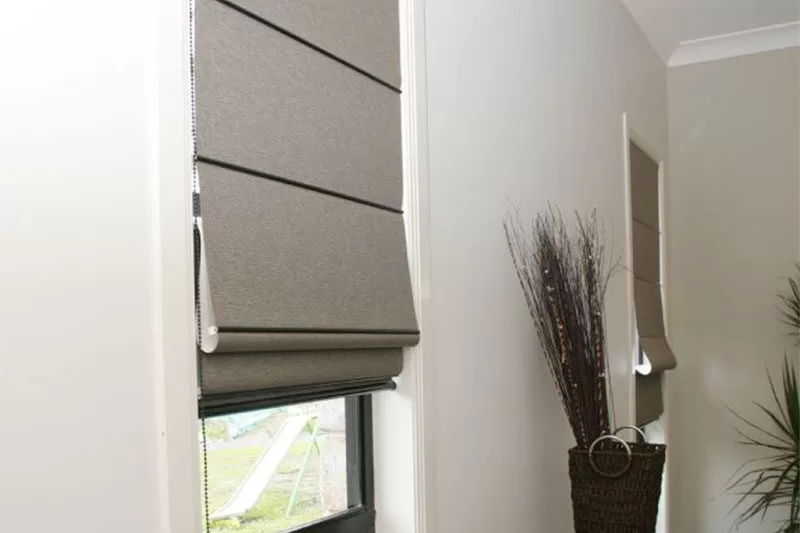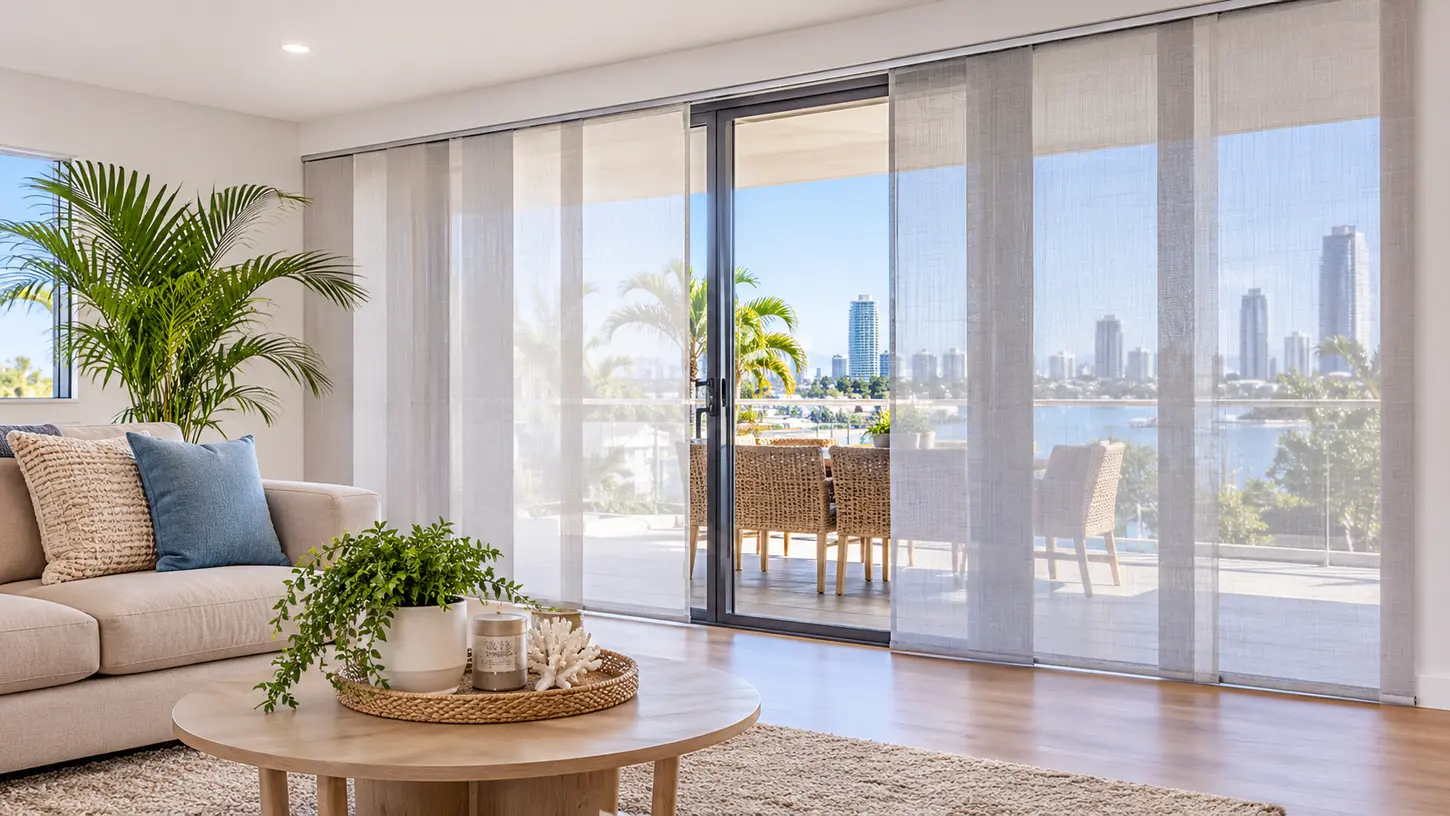

Sliding doors are one of the hardest-working features in many Gold Coast homes. They open living areas onto the patio, deck or balcony, bring in plenty of natural light and make the most of the indoor-outdoor lifestyle we enjoy here. When it comes to choosing window blinds for them, though, the usual rules don’t always apply.
A sliding door is wider than most windows, it’s used many times a day, and its large glass panels let in a lot of light. Each of those factors affects which blinds will work well and which will become a daily annoyance. In this guide, we’ll walk through the blind styles that suit sliding doors best, how to plan stacking direction and clearance, which fabrics to consider and what to think about before booking a measure and quote with Award Carpets Gold Coast.
Why Sliding Doors Need Different Blinds
Sliding Doors Have Different Requirements from Standard Windows
Most windows are relatively compact openings, and many blinds are designed with that scale in mind. Sliding doors are a different proposition. Even a standard two-panel door is usually wider than a typical window and runs close to floor level, while three-panel and stacker doors can take up much of a wall.
That’s why conventional window blinds aren’t always the right fit. A single roller blind may not be practical across the full width, so several blinds are often needed side by side, and Venetian blinds become heavier and less convenient to raise as they get wider. What works as the best blinds for homes with standard windows doesn’t automatically translate to a large glass door.
The general principles of choosing the right window blinds still apply, but sliding doors add another layer: opening direction and stacking configuration. On a window, a blind only needs to clear the glass. On a sliding door, it also needs to stack somewhere that leaves the active door panel completely clear.
Maintaining Easy Access to Outdoor Areas
Sliding doors usually get far more use than windows. A door leading to a patio, balcony, deck or outdoor entertaining area might be opened many times a day, especially in the warmer months when everyone is moving in and out.
That means the blind needs to move smoothly and reliably, and when it’s open, it needs to sit clear of the doorway. A blind that looks lovely when closed but gets in the way every time someone heads outside isn’t the right choice for that door.
Managing Light, Glare and Privacy on Large Glass
Large glass doors can bring substantial sunlight into a living space, which is a big part of their appeal. At certain times of day, though, that light can cause glare on televisions, computer screens and reflective flooring, and make a room uncomfortably bright.
Privacy is the other challenge. An uncovered glass door offers little privacy from neighbours, the street or shared outdoor areas, and some lighter fabrics that seem private during the day can become see-through at night once the lights are on inside.
The window furnishings that work best on sliding doors let you adjust light and privacy without compromising access. We cover fabric choice and Gold Coast sun exposure in more detail further down.
Best Types of Blinds for Sliding Doors
There are many types of window blinds, but only some are genuinely well suited to the width and daily use of a sliding door. Panel glide blinds, vertical blinds and Veri Shades are usually the strongest options, while Holland, motorised and Venetian blinds suit particular situations.
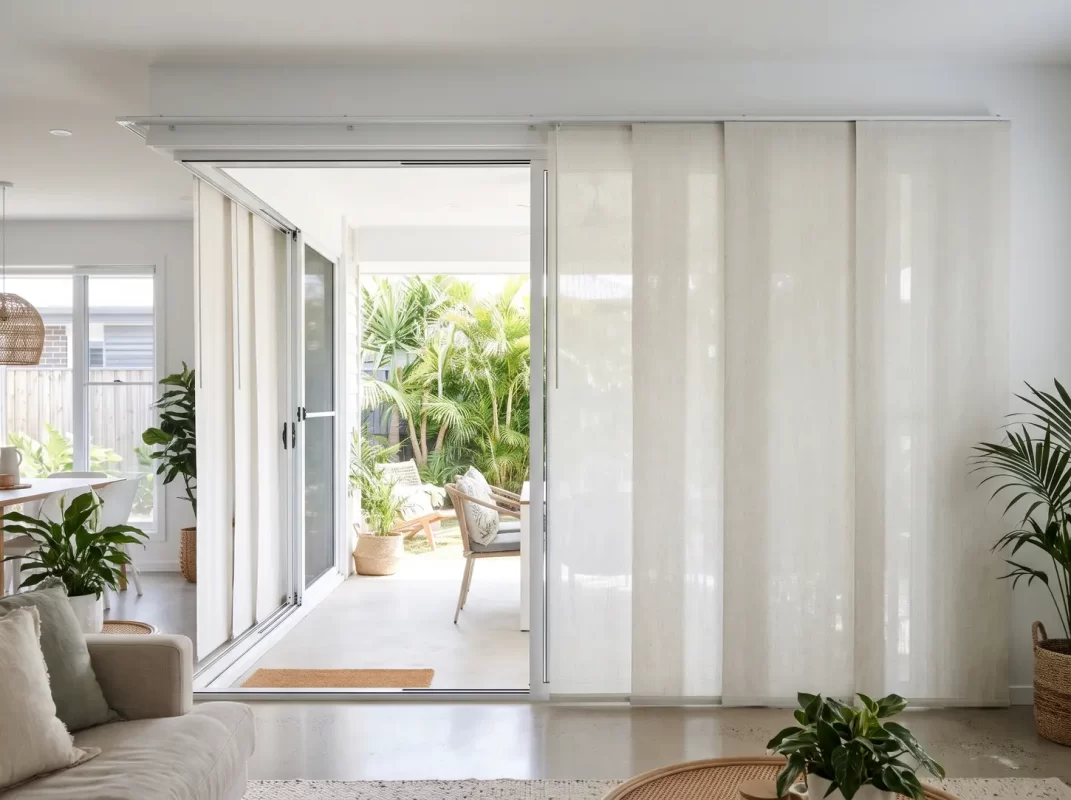
Panel Glide Blinds – A Modern Choice for Large Sliding Doors
Panel glide blinds use a series of wide, flat fabric panels that slide horizontally along a track. Using a wand, you glide the panels across the glass, and when the blind is open they overlap neatly, either stacking to one side or splitting from the centre, depending on the configuration.
Because the panels travel sideways, just like the door itself, they feel natural to use on a sliding door. They’re particularly well suited to wide two-panel doors, three-panel doors and stacker doors, where a single run of broad panels can cover a large span without the visual breaks you’d get from several separate blinds.
The look is clean and uncluttered, which makes panel glides a natural fit among modern window coverings for open-plan living areas and rooms with floor-to-ceiling glass. Fabrics are available in blockout, filtered-light and decorative options across a broad colour range, so the panels can be coordinated with your flooring, walls and furniture.
Advantages:
- Contemporary, streamlined appearance
- Particularly suitable for wide sliding and stacker doors
- Wide fabric panels create a clean, uncluttered look
- Left, right and centre-opening configurations
- Simple wand operation
Things to consider:
- Stacked panels take up some space beside the opening when the blind is open
- The stacking position should be planned around the side of the door you use most
- Fabric selection affects privacy and how much light filters through
- Wide fabric panels collect dust and should be cleaned according to the fabric care instructions
We make custom panel glide blinds to suit the individual opening, in left, right and centre-opening configurations.
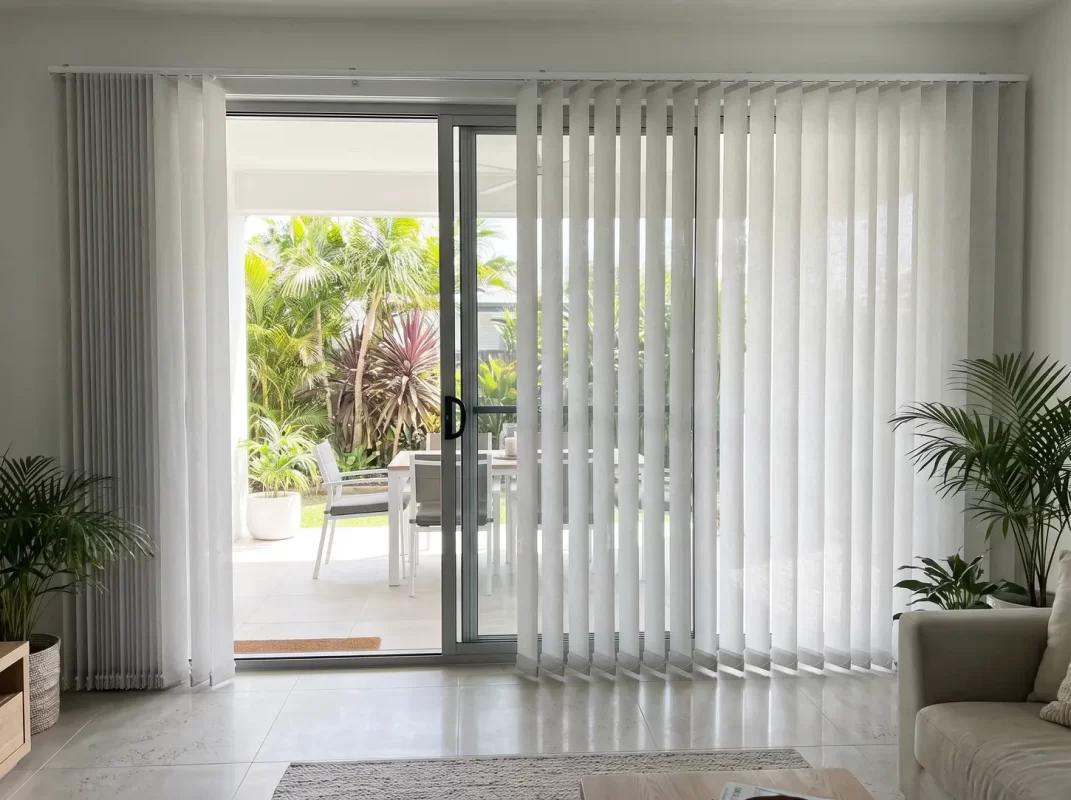
Vertical Blinds – A Practical Option for Sliding Glass Doors
Vertical blinds are made up of individual fabric blades that hang from a track above the opening. The blades rotate to control the amount and direction of light coming in, and they traverse along the track to stack to one side when you need to use the door.
That combination makes vertical blinds a long-standing, practical choice for sliding and patio doors. Tilt the blades partway to soften afternoon glare while keeping some privacy, close them fully for more privacy, or draw them aside completely when you’re heading outside. They work just as well on large windows, so the same style can be carried across a whole wall of glass.
Blade width affects both the look of the blind and how it suits the scale of the opening, with 89mm, 100mm and 127mm options available. The bottom weights can be chained, chainless or sewn in, depending on how you’d like the blind to look and operate, and fabric colours and textures can be matched to the room.
Advantages:
- Flexible light and privacy control
- Suitable for wide windows and sliding doors
- Blades draw aside quickly when you need access
- Practical for homes, rentals, offices and commercial spaces
Things to consider:
- Blades can move when a breeze comes through the open door
- Their appearance may not suit every contemporary interior
- Tracks and blades need some maintenance over time
Our custom vertical blinds are made to the height and width of your opening, with a choice of fabrics, blade widths and finishing options.
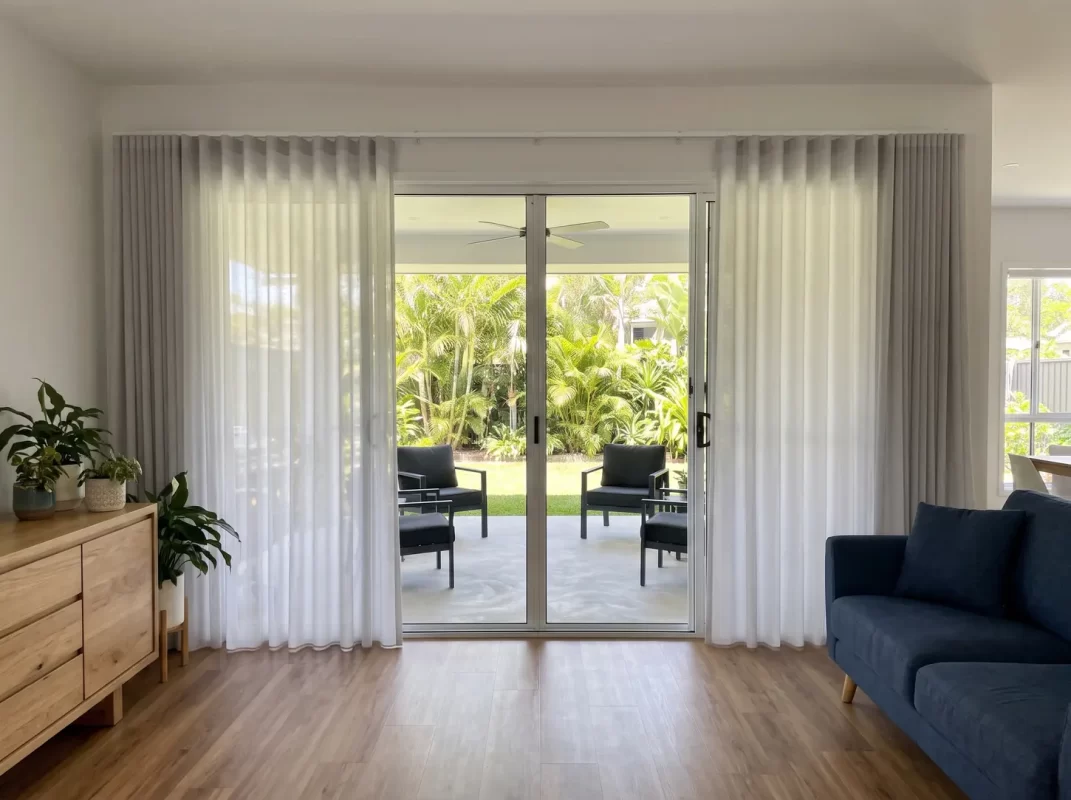
Veri Shades – Combining the Look of Curtains and Blinds
Veri Shades combine the soft, draped look of a curtain with the adjustable light control of a blind. Alternating opaque and translucent fabric sections hang from a single track, and a simple adjustment changes the balance between filtered light, an outward view and greater privacy. You can turn the sections to suit the time of day, the angle of the sun or how much privacy you need.
The feature that stands out for sliding doors is the walk-through design. Veri Shades have no bottom weights or connecting chains, so you can walk through them without drawing the whole furnishing aside, which is handy on a door that’s used constantly through the day. They’re also designed with children and pets in mind.
Compared with traditional vertical blinds, Veri Shades have a softer, more flowing appearance that suits living rooms and dining areas particularly well. A room-darkening configuration is also available, so they aren’t limited to lighter daytime fabrics.
Advantages:
- Soft, contemporary appearance
- Curtain-like styling with the practical control of a blind
- Flexible control over light, view and privacy
- Walk-through design with no bottom weights or chains
- Room-darkening configuration available
Things to consider:
- Fabric selection affects light filtration and privacy
- The softer, fuller look may not suit very minimalist interiors
- Think about how the fabric sections will hang around a frequently used doorway
Our Veri Shades are made to measure and are well worth a look for living and dining areas where appearance and flexibility matter equally.
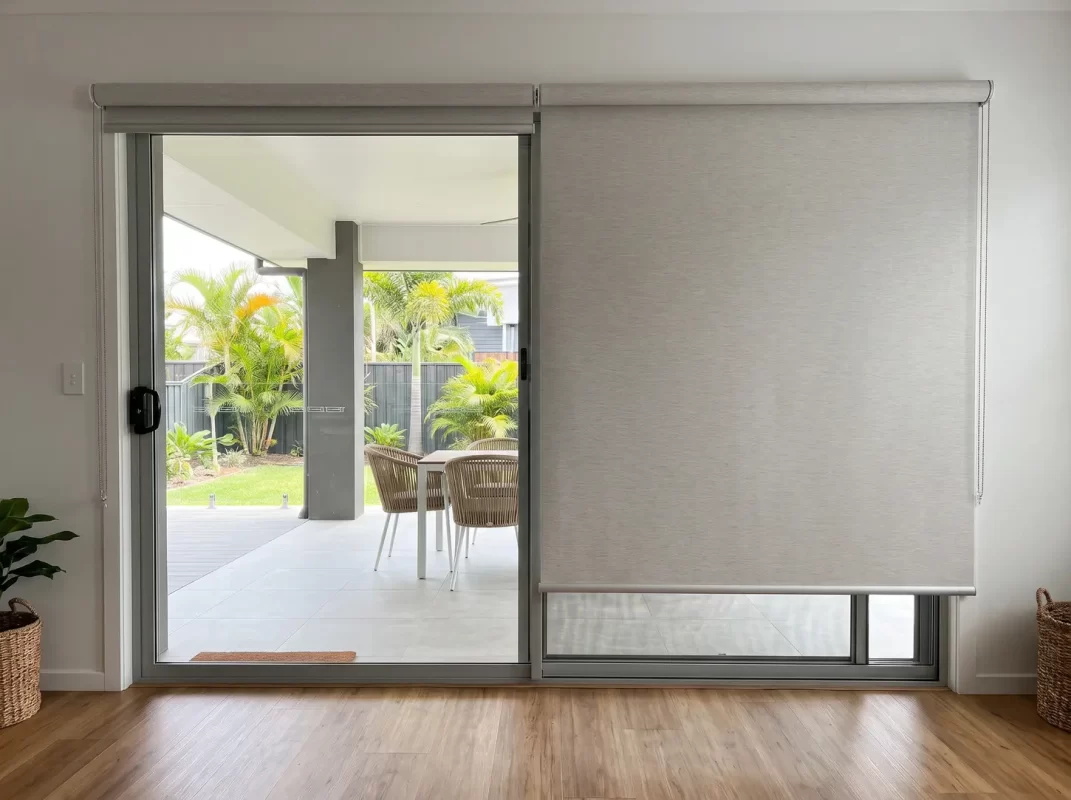
Holland (Roller) Blinds – A Simple and Streamlined Solution
Holland blinds, also known as roller blinds, are one of the simplest blind styles. A single piece of fabric winds around a tube mounted at the top of the opening, lowering to cover the glass and rolling up out of the way when you want the view back. Their minimal look suits contemporary interiors and is easy to coordinate with most rooms.
On a sliding door, Holland blinds are usually installed as two or more separate blinds side by side, each operating independently. On a two-panel door, for example, one blind can cover each panel, so you can raise the blind over the active panel while leaving the other lowered. Wider openings may need three or more blinds, so the width and height of the door, and where each blind meets the next, should be worked out at the planning stage.
Fabrics include blockout for greater room darkening, sunscreen for filtered daytime light and light-filtering options for a softer effect. You can also choose a round, oval or flat bottom rail to suit the interior, and motorised operation is available for selected configurations.
Advantages:
- Clean, minimalist appearance
- Wide choice of colours and fabrics
- Easy to coordinate with existing interiors
- Available in light-filtering, sunscreen and blockout fabrics
Things to consider:
- Large openings may require multiple blinds
- Small gaps can appear between neighbouring blinds
- The rolled fabric occupies some space above the opening
We offer custom Holland blinds in a broad selection of fabrics and finishes.
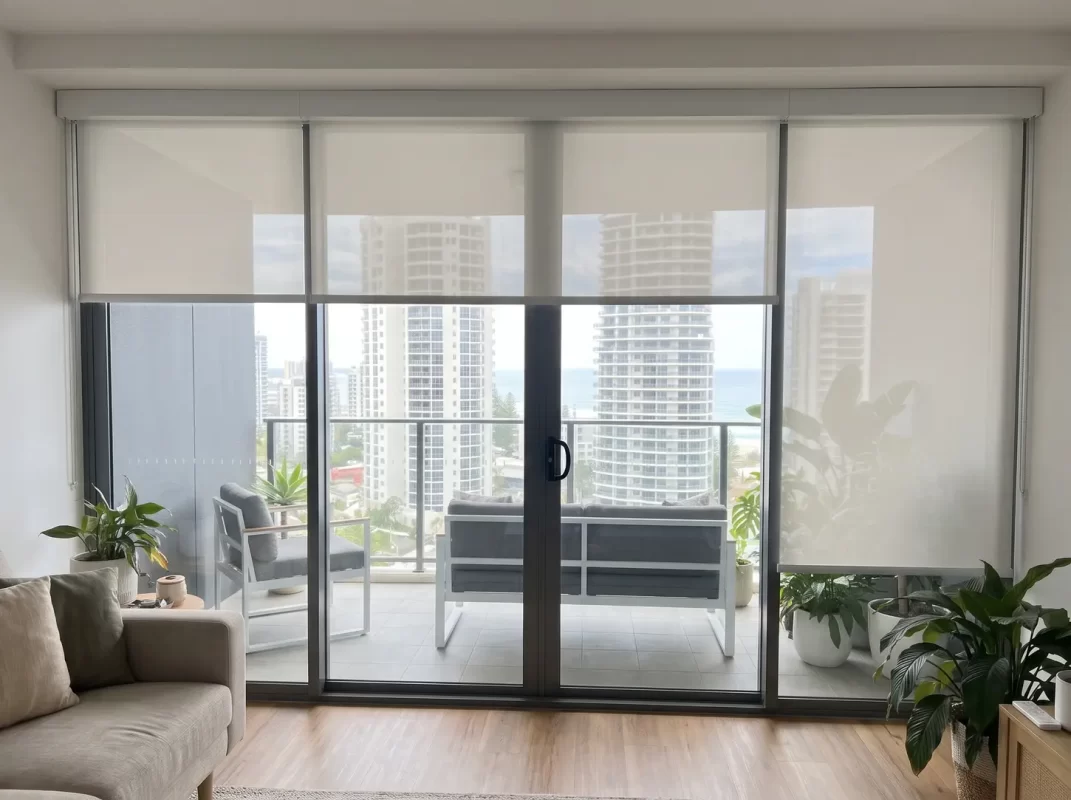
Motorised Blinds – Convenience for Large Sliding Doors
Motorised blinds use an electric motor in place of manual controls such as chains or cords. Instead of reaching across a wide opening to operate each blind by hand, you can raise and lower it with a remote control, and several compatible blinds can be operated together.
That makes motorisation worth considering for large sliding doors, floor-to-ceiling glass, hard-to-reach windows and openings covered by more than one blind. Depending on the blind and motor, options can include mains-powered motors, rechargeable or battery-operated systems, and selected smartphone-control configurations. Without manual operating chains, motorised blinds also have a cleaner, cord-free appearance around the door.
Motor suitability depends on the blind type, dimensions, fabric weight and installation, and smart-control functions require compatible motors and additional control hardware. Holland blinds are a popular choice for motorisation.
Advantages:
- Convenient everyday operation
- Particularly useful for larger or multiple-blind installations
- Clean appearance without manual operating chains
- Selected smartphone-control configurations available
Things to consider:
- Additional equipment and installation costs
- Power requirements, including recharging or battery replacement for battery-operated systems
- Compatibility between the blind and the selected motor
Our motorised blinds are matched to the blind size and application, and we’re happy to talk you through the options during your measure and quote.
Venetian Blinds – Are They Suitable for Sliding Doors?
Venetian blinds use horizontal slats that tilt to control the direction and amount of light entering the room. Angle them to reduce glare while keeping natural light, close them for privacy, or raise the blind to clear the glass. Aluminium Venetians come in 25mm and 50mm slats and have a crisp, practical finish, while timber Venetians come in 50mm and 63mm slats and bring a warmer, more substantial look.
For sliding doors, Venetians generally suit narrower door sections or adjoining windows better than a very wide opening. The blind has to be raised fully to clear the doorway, and larger blinds are heavier to operate, which can become tiresome on a door you use all day. Where a door handle or similar obstruction is in the way, cut-out solutions may be available.
If you’d like a softer fabric look on a window beside the door, Roman blinds are worth considering. For a more architectural option, plantation shutters can also suit adjoining windows.
We offer custom Venetian blinds in both timber and aluminium.
Comparing the Best Blinds for Sliding Doors
| Blind type | Best suited for | Main advantage | Main consideration |
| Panel glide | Wide sliding and stacker doors | Modern appearance and wide panels | Stacking space |
| Vertical | Large glass doors | Adjustable light and privacy | Blades can move in a breeze |
| Veri Shades | Living and dining spaces | Soft, curtain-like appearance | Fabric choice and clearance around the doorway |
| Holland (roller) | Contemporary interiors | Simple, streamlined design | Multiple blinds may be needed |
| Motorised | Large or frequently used openings | Convenient operation | Motor and power requirements |
| Venetian | Narrower openings and adjoining windows | Adjustable slats | Less convenient across wide doors |
Which Blind Type Is Best for a Two-Panel Sliding Door?
Holland, vertical and panel glide blinds all suit a standard two-panel sliding door, but each works a little differently.
- Holland blinds: Two side-by-side blinds give a clean, minimal look, and each can be raised independently. Because they roll up above the opening, they don’t need wall space beside the door.
- Vertical blinds: These give flexible light control across the full width and draw aside into a relatively compact stack.
- Panel glide blinds: These create a broad, cohesive look across the glass, but the stacked panels need somewhere to sit when the blind is open.
The wall space beside the opening often settles the decision. If the door sits close to a corner or return wall, there may not be enough room for panels to stack clear of the active door panel. Whichever style you choose, make sure the active panel can open freely without the blind getting in the way.
Which Blinds Work Best for Three-Panel and Stacker Doors?
For wider three-panel and stacker doors, panel glide and vertical blinds are both worth considering because they cover large spans in a single run. Both can be configured to stack to one side or open from the centre, depending on how the door is used.
Measure the complete opening, not just the section you use most. Stacker doors slide together at one end, and the blind needs to stack clear of that point when it’s open. Getting this right at the planning stage helps avoid coverage gaps and blinds that stack in the wrong place.
What About Corner and Floor-to-Ceiling Glass?
Corner glass, where two glass walls meet, needs careful planning. Each blind’s stacking direction has to work alongside the other so that neither blocks the doorway or the adjoining glass when open, and the point where the two blinds meet needs some thought. Track positions and fixing points may also differ from a standard single-wall installation.
Floor-to-ceiling glass raises its own questions, including the height and weight of the blind, how it will be operated day to day and where the hardware will be fixed. If you have corner glass or an unusually tall opening, mention it when you book so it can be assessed during the measure and quote.
Which Blinds Are Best for Frequently Used Patio Doors?
On a door that leads to the patio, deck or outdoor entertaining area, ease of operation matters as much as appearance.
- Vertical blinds draw aside in one smooth movement.
- Panel glide blinds glide across easily, particularly in one-way configurations where every panel stacks away from the active door panel.
- Veri Shades let you walk through without drawing the whole furnishing aside.
Whichever you choose, the blind’s position when open matters just as much as how it looks when closed. A blind that intrudes into the doorway, even slightly, quickly becomes an everyday nuisance.
Planning Stack Direction and Clearance
Think About Which Direction Your Blinds Should Open
Working out how to choose blinds for a sliding door often comes down to one practical question: where will the blind sit when it’s open? The main options are:
- One-way opening (left or right stacking): All panels or blades stack to one side. This suits doors where the active panel is at one end and there’s enough wall space at the other.
- Centre-opening: The blind splits in the middle and stacks to both sides. This can suit wider openings where a single stack would be bulky, or where the doorway sits in the middle of the run.
As a general rule, the blind should stack away from the side you use most. If the right-hand panel of your sliding door is the one you open each day, stacking the blind to the left keeps the doorway clear.
Check Handles, Furniture and Surrounding Wall Space
Stacked panels and drawn blades shouldn’t obstruct the part of the doorway you use most. Before you settle on a style and configuration, check that:
- the stack won’t sit over the door handle or make it awkward to reach
- there’s enough wall space beside the opening for the stack
- nearby furniture won’t get in the way of the panels or blades
- the blind won’t press against a return wall or cabinetry
We look at the full opening and the surrounding space during the measure and quote, which helps pick up clearance issues before anything is made.
Choosing Fabrics for Large Glass Doors
When choosing window blinds for large glass doors, fabric has as much influence on day-to-day performance as the blind style. The blockout, sunscreen and double roller arrangements below are fabric and configuration options within our blind ranges, and availability depends on the blind style you choose.
Sunscreen and Light-Filtering Fabrics for Daytime Glare
Sunscreen fabrics have an open weave that filters daylight and reduces glare while still letting you see outside. They’re well suited to living rooms, dining areas and open-plan spaces where the view through a large glass door is part of the appeal.
Light-filtering blinds take a softer approach. The fabric diffuses daylight so the room stays bright without harsh glare, though it generally doesn’t preserve the outward view the way sunscreen fabric does. Either option can make a large glass door more comfortable during the brightest part of the day.
Blockout Fabrics and Night-Time Privacy
Sunscreen fabrics can offer a degree of daytime privacy because it’s usually brighter outside than in. At night the situation reverses: with the lights on inside, people outside may be able to see shapes and movement through the fabric. That’s worth considering if the door faces neighbouring properties, a nearby street or a shared outdoor area.
Blockout fabrics are designed to stop light passing through the fabric itself, which makes them effective privacy blinds and a common choice for bedrooms and media rooms. Some light can still escape around the edges, depending on how the blind is installed. Blinds fitted inside the recess usually have small gaps at the sides, while face-fit blinds that overlap the opening can reduce, though not always eliminate, light around the edges.
Double Roller Blinds for Day-and-Night Flexibility
A double roller combines two roller blinds on one fitting, usually a sunscreen or light-filtering fabric paired with a blockout fabric. You can lower the sunscreen blind during the day to cut glare while keeping the view, then lower the blockout blind at night for more privacy.
On a sliding door, it’s worth checking whether a double roller suits the width and configuration of the opening. A wide door may need several double rollers side by side, and the extra hardware needs suitable space above the opening. We can confirm whether it’s a practical fit during the measure and quote.
Choosing Blinds for Sliding Doors in Gold Coast Homes
Managing Strong Sunlight and Door Orientation
The direction a sliding door faces has a big influence on which fabric will suit it.
- North-facing doors: In the Southern Hemisphere, north-facing glass receives sun for most of the day, so glare control matters across a long stretch of hours.
- East-facing doors: These receive morning sunlight, which can be bright early on but usually eases by the middle of the day.
- West-facing doors: These receive strong afternoon sun and are often the hardest to manage, as the lower sun angle late in the day can send glare deep into the room.
Sunscreen and light-filtering fabrics can help manage glare and reduce UV exposure while keeping the room comfortably lit. Performance varies between fabrics, so it’s worth asking about the characteristics of any fabric you’re considering rather than assuming every option will perform the same way.
Blinds for Coastal and Beachside Homes
Coastal and beachside homes on the Gold Coast often lean towards relaxed interiors with neutral colours, soft textures and understated design. Panel glide blinds and Veri Shades in light, natural tones suit this style well, as do Holland blinds in simple neutrals.
Coastal living brings practical considerations too. Sand, salt residue and humidity can mean blinds and tracks need cleaning more often in homes close to the water. Not every fabric or component is necessarily suited to salt-air exposure, so check the suitability of a specific product for your location rather than assuming all options will perform equally.
Blinds for Gold Coast Apartments and Balconies
In apartments, the sliding door is often the main link between the living area and the balcony. Openings can be more compact than in a freestanding house, and neighbouring buildings can make privacy a priority.
Panel glide and Holland blinds both suit the clean lines of many modern apartment interiors. A compact configuration, such as two Holland blinds or a short run of panel glides, can cover the door without crowding a smaller living area. Sunscreen fabrics can reduce visibility from nearby buildings during the day while keeping the view, though a blockout option may be worth considering for evening privacy.
Before you choose colours or an installation method, check your building’s body corporate by-laws. Some schemes have rules about how window coverings look from outside, so it’s best to confirm what’s permitted with your body corporate before ordering.
Blinds for Open-Plan Living and Outdoor Entertaining Areas
In open-plan homes, a sliding door is often part of a larger wall of glass that includes fixed windows. Because it connects the main living area with the outdoor entertaining space, it’s frequently the most-used opening in the house, so convenient operation should be a priority.
Where windows sit beside the sliding door, consider using the same or a complementary fabric across all of them. Looking at the whole wall together, rather than treating each opening separately, helps create a cohesive look across the room.
Custom-Made Blinds and Professional Measuring
Why Sliding Doors Usually Need Custom-Made Blinds
Custom-made blinds are manufactured to the dimensions of your specific opening, with the fabric, colour and configuration chosen for that door. Because sliding doors vary so much in width and height, and because stacking direction affects how the door is used, custom blinds are usually the more practical choice. They can also accommodate unusual sizes, such as extra-wide stacker doors or very tall glass.
Advantages of custom-made blinds:
- More precise fit
- Greater choice of fabrics and colours
- Different opening and stacking configurations
- Better coordination with your existing interior
- Options for larger or non-standard openings
Are Ready-Made Blinds Suitable for Sliding Doors?
Ready-made blinds come in set sizes, and sliding doors rarely match them exactly. The result can be gaps at the sides, a blind that’s too narrow or too long, or hardware that doesn’t sit correctly on the frame. Fabric and configuration choices are also more limited.
Ready-made blinds can work for a small, standard-sized opening or as a short-term fix. For most sliding doors, though, a custom blind is the more reliable way to get good coverage and smooth operation.
Why Professional Measuring Matters
Measuring a sliding door is more involved than measuring a window. The full opening needs to be measured, including fixed and sliding panels, along with the space available for the blind to stack, the position of handles and locks, and any nearby walls or furniture.
The installation method changes the measurements too. An inside-mount (recess-fit) blind sits within the frame, while a face-fit blind is fixed to the wall or frame above the opening and overlaps it. Recess-fit can work where there’s a deep architectural reveal, but many aluminium sliding doors sit close to flush with the internal wall, leaving little depth for a track. Add a door handle that protrudes into the room, and face-fit is usually needed so the blind clears both the frame and the handle. Door frames, tracks, handles and surrounding wall space all affect which method will work, along with how the track is positioned and aligned.
Incorrect measurements can lead to gaps, poor coverage, blinds that won’t stack clear of the doorway or hardware that can’t be installed as planned. That’s why measuring is part of our free measure and quote.
What Affects the Cost of Sliding Door Blinds?
The cost of custom blinds on the Gold Coast depends on several factors, including:
- the overall width and height of the opening
- the blind type and operating mechanism, as panel glide and vertical blinds use different tracks and construction
- fabric quality and opacity
- manual or motorised operation
- the number of panels or blinds required
- customisation and installation requirements
Because every sliding door is different, the most reliable way to get an accurate price is through our free measure and quote.
Before You Book a Measure and Quote
A few minutes with this checklist will help you get the most out of your appointment:
- Which section of the door do you use most, and where should the blinds stack?
- Have you considered the full opening, including any adjoining windows?
- Do you need privacy at night as well as during the day?
- Which direction does the door face, and how much afternoon sun does it receive?
- Have you balanced appearance with everyday convenience, such as the difference in operation between vertical and panel glide blinds?
- Have you checked the fabric’s cleaning instructions and how it’s likely to hold up in strong sunlight?
- If you have young children or pets, would cordless or motorised operation suit your home better? Corded internal window coverings supplied in Australia must comply with the mandatory safety standard for corded internal window coverings.
- Which blind types and fabrics have you shortlisted?
Why Choose Award Carpets for Blinds on the Gold Coast?
Explore a Range of Custom-Made Blind Styles
At Award Carpets Gold Coast, our range of window furnishings for Gold Coast homes includes panel glide, vertical, Holland, motorised, Roman and Venetian blinds, as well as Veri Shades. Each style suits different window and door configurations, from compact balcony doors to wide stacker doors and the windows around them.
Find Blinds That Suit Your Home and Lifestyle
Choosing window blinds for a sliding door involves more than the size of the glass. Privacy, sunlight, the way the room is used and how often the door is opened all play a part. Window blinds for different rooms often call for different solutions: a living room door might need glare control and easy access, while a bedroom door might need blockout fabric for privacy and room darkening.
Fabric and configuration choices can be tailored to each opening, so you can balance appearance with everyday practicality.
Arrange a Free Measure and Quote
Our team can talk through your requirements, measure your sliding door and any adjoining windows, and suggest blind styles and fabrics to suit your home. If you’re also planning new floors, you can consider your blinds and flooring together for a coordinated interior.
Explore our blinds range, including panel glide blinds, vertical blinds and Veri Shades, and arrange a free measure and quote when you’re ready.
Frequently Asked Questions About Blinds for Sliding Doors
What Are the Best Blinds for Sliding Glass Doors?
Panel glide blinds, vertical blinds and Veri Shades are among the most practical options for sliding glass doors, with Holland (roller) blinds also suiting many openings. Panel glides suit wide openings and modern interiors, vertical blinds offer flexible light control and draw aside easily, and Veri Shades combine a soft, curtain-like look with a walk-through design. Holland blinds give a simple, minimal look using two or more blinds side by side. The best option depends on the door’s dimensions, how often it’s used, your privacy needs and the style of the room.
Are Panel Glide Blinds Better Than Vertical Blinds?
Neither is better in every situation. Panel glide blinds have a more contemporary look, with wide fabric panels giving broad, continuous coverage that suits wide and stacker doors. Vertical blinds offer finer light control because the blades can be tilted, and they usually stack more compactly, which helps where wall space beside the door is limited.
Can You Put Roller Blinds on Sliding Doors?
Yes. Roller blinds are usually installed as two or more individual blinds side by side across a sliding door, so each section can be raised or lowered independently. Small gaps can appear between neighbouring blinds, so it’s worth discussing the layout if privacy is a priority.
What Blinds Provide the Most Privacy for Sliding Doors?
Blockout fabrics provide the most privacy, day and night. Sunscreen fabrics can offer some privacy during the day while keeping the view, but with the lights on at night, shapes and movement may be visible from outside. Light-filtering fabrics sit in between, softening light and obscuring the view more than sunscreen fabric, though they aren’t as private as blockout.
Can You Get Motorised Blinds for Sliding Glass Doors?
Yes, motorisation is available for selected blinds, and Holland blinds are a popular choice. Motorised blinds can be operated by remote control, with mains-powered, rechargeable and battery-operated options and selected smartphone-control configurations. Suitability depends on the blind type, size, fabric weight and installation.
Are Panel Glide Blinds Suitable for Stacker Doors?
Yes. Panel glide blinds slide horizontally like the door itself, and their wide fabric panels can cover a large span in a single run. Left, right and centre-opening configurations allow the stack to be positioned to suit the way the door opens.
Can Sliding Door Blinds Help Reduce Heat and Glare?
Blinds can help manage glare and the amount of direct sunlight entering a room. Sunscreen and light-filtering fabrics reduce glare while keeping the room bright, and blockout fabrics restrict light more fully. How much difference they make to indoor comfort depends on the fabric, the door’s orientation and the room itself, so it’s best to ask about specific fabrics when comparing options.
How Do You Clean Sliding Door Blinds?
The right method depends on the blind type and fabric, but as a general guide:
- Tracks: Dust or wipe them regularly so the blind keeps operating smoothly.
- Vertical blades and panel glide fabrics: Many can be dusted or gently vacuumed with a soft brush attachment, with spot cleaning for small marks where the fabric allows.
- Holland blind fabric: A light wipe with a damp cloth suits many fabrics, but avoid soaking the material.
Always follow the manufacturer’s fabric-specific cleaning instructions, and ask our team if you’re unsure what suits a particular fabric.
Finding the Right Fit for Your Sliding Doors with Award Carpets Gold Coast
The right blind for a sliding door is one you don’t have to think about each time you head outside. It should stack where you need it to, give you the light and privacy you want, and suit the room it’s in. For many Gold Coast homes, panel glide blinds, vertical blinds and Veri Shades are the natural starting points, with Holland, motorised and Venetian blinds filling more specific roles.
If you’re weighing up options for a patio, balcony or stacker door, our team is happy to help you compare styles and fabrics with accurate measurements in hand. Browse our custom blinds and get in touch to arrange a free measure and quote.